
Killeshandra was no Kilmichael
Evaluating the effect of Rebel Songs
In recent times the singing of rebel songs in public has often drawn negative comment in the media. The Taoiseach, Leo Varadkar, gave his views on the contentious subject when he said that a republican ballad, which can be a nice song to sing for some people, can be deeply offensive to others. He went on to say that if the country is going to be united then we must consider how words and songs might be heard by others.
One of the songs most often highlighted in this regard is the Dominic Behan penned ‘Come Out Ye Black and Tans’. This song was written in the early 1960’s and so predates the ‘ferocious trauma’ of the Troubles that an earlier Taoiseach, Bertie Ahern, recently referred to. He said in the same context that while the younger generation were only singing these songs out of joy ‘it beholds us to try to explain to them what happened during the Troubles’. If we do need to look at educating people we surely need to decide which songs, in terms of their lyrics and context, can be adjudged to be unacceptably offensive to sections of society. We need to look at what the lyrics contain, with what intention they were written and with what effect.
In the case of Dominic Behan’s song ‘Come Out Ye Black and Tans’ we are fortunate to have a substantial amount of information to assist a proper assessment. Dominic Behan was born in Dublin in October 1928 into a very talented family which included his older brother, Brendan Behan, who would go on to become a famous playwright and writer. The Behan family were heavily involved in the Republican tradition. Their father, Stephen took part in the War of Independence and Civil War. Their uncle, Peadar Kearney, wrote ‘The Soldiers Song’, the original English version of our national anthem, and Brendan was sentenced to three years in Borstal after being arrested on bomb charges in Liverpool while still a teenager. Dominic’s own involvement in the Fianna, the junior wing of the Republican movement, is detailed in his autobiographical book ‘Teems of Times and Happy Returns’ published in 1961 around the time he wrote ‘Come Out Ye Black and Tans’. The dust jacket on Dominic’s 1961 book states that the story of his tenement childhood in Russell Street, Dublin is made fresh by his ‘humour and gently sardonic wit’, traits that would also carry across into the lyrics of ‘Come Out Ye Black and Tans’ in different measure.
The song itself is probably the most popular War of Independence-related song at the present time. It is an excellent composition in many respects, catchy, anthemic and with a rousing chorus. The song was written for, and about, Dominic’s father Stephen. It accurately depicts the divided loyalties and tensions that existed between nationalist and pro-British working-class neighbours in the crowded inner Dublin of the early 20th century, which were capable of boiling over at times. There were tensions over divided loyalties within families as well as between neighbours. Dominic’s mother, Kathleen Behan, in her autobiographical book ‘Mother of all the Behans’ states that ‘The men of her family and my husband were all in Jacob’s biscuit factory’ in 1916 with the result that the Behans were referred to as ‘Bloody Old Fenians’ during the drunkenness, swearing and shouting that Kathleen said attached to Saturday nights in Russell Street. However, Dublin family allegiances weren’t always totally one dimensional and Kathleen also tells us that many of the family went off to fight for the British in WW1. She also states that her brother-in-law James, Stephen’s younger brother, was killed in the Somme and is memorialised on the Arch to the Fallen in St. Stephen’s Green. While there is a Pte. J. Behan listed on that monument, which was sometimes referred to as Traitors Gate, it was erected to the fallen of the 1899-1900 Boer War. However a James Behan, with a Russell Street family address, is memorialised on the Menin Gate at Ypres and that might be the cause of Kathleen’s confusion.
The conflict in the Behan family’s own allegiances continued into her children’s generation and WW2 when her son Brendan was imprisoned as a Republican in the Curragh during the Emergency with Rory, another son, a member of the Irish Army guarding the camp, and a third son, Seamus, enlisted in the RAF to fight fascism. Sing-songs in the Behan family thereafter must have been lively affairs!
‘Come Out Ye Black and Tans’ also takes aim at the excesses of British colonialism and empire building in the Middle East and Africa. The lyrics however are somewhat tongue in cheek with elements of parody that juxtapose ‘the green and leafy lanes of Killeshandra’ with the killing fields of WW1 Flanders. There is nothing particularly heroic about the alcohol fueled bravado of the writer’s father that underpins the song, it is not a rebel song in the conventional sense. In his autobiographical book, Dominic Behan states that ‘Da was always drunk on Saturday night’. Dominic also provides a humorous dismissive account of his father’s IRA career; saying that in the IRA his father was known as Rosy ‘in honour of the chief hostess of a Dublin brothel where he had slept while on the run from the Black and Tans’. When he was arrested, after transferring to a different sanctuary, his IRA commanders were relieved that he hadn’t been apprehended in a house of ill-repute!
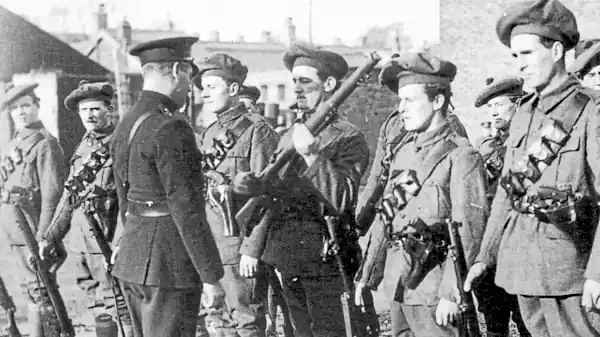
If one were pressed to write a song about a rout of British forces in the War of Independence by the IRA, Killeshandra in Co. Cavan is not somewhere you would look to for inspiration. A more conservative songwriter might opt for the likes of Kilmichael in Co. Cork where an Auxiliary force of 18 were nearly entirely wiped out in an ambush in November 1920. Cavan experienced a low intensity war, with less than 10 fatalities in total, by comparison Cork experienced in excess of 500 fatalities. The IRA in Cavan were largely inactive in terms of military engagements but they did carry out a fairly comprehensive program of boycott and intimidation of RIC members and their families. On the other hand, if you were looking for a good example of the mixed allegiances that pertained in Ireland at the time then Killeshandra was an excellent example. The Derrylane, Killeshandra loyalist UVF unit had 450 members in 1913 and the following year, with the outbreak of WW1, Killeshandra was named in Cavan’s Anglo-Celt newspaper as one of the county’s best areas for the British Army’s recruitment drive, but mostly from the ranks of the National Volunteers.
The specific incident in Killeshandra that Behan’s song refers to did not occur until nearly a year after the Truce that ended the War of Independence, and after the disbandment of the RIC and the Black and Tans. On the 20th May 1922 the Anglo-Celt reported that ‘armed men visited a number of ex-RIC and ex-Black and Tans in Killeshandra and gave them a few days to leave the county’. While the report is no doubt a reasonably accurate contemporaneous account, it somehow lacks the immediacy and the punch of the more memorable lyrics by Dominic Behan. It is not evident how Dominic became aware of the fairly unremarkable Killeshandra incident. One possible interpretation of the chorus:
‘Tell her how the IRA made you run like hell away
From the green and lovely lanes of Killeshandra’
could suggest that some of the Killeshandra evacuees ended up as neighbours of the Behans in Dublin’s Russell Street.
This song is by now part of our island’s cultural heritage and of value in its own right. Evoking themes of republicanism and anti-Imperialism, it is a piece of social commentary and history. The song has a big following, an indication of which is the millions of plays it attracts on music streaming networks, both from Ireland and from abroad, judging by the accompanying comments. While listeners outside Ireland might struggle to fully understand the complexity of relations between neighbours of different allegiances in the Dublin of Dominic Behan’s youth, they appear to have no problem in grasping his withering disdain for Britain’s colonial pursuits, and it’s use of vastly superior military force to overcome and frighten ‘them damn natives to the marrow’.
The song has its critics as well, many of whom would have issues with its pro-IRA sentiments. As previously mentioned the song pre-dates the Troubles and Dominic Behan himself was not in favour of the Provisional IRA’s campaign. The acclaimed book Lost Lives states that the IRA were responsible for 1768 of the 3720 deaths it attributes to the Troubles, and that 639 of the IRA’s victims were civilians. This situation has left a legacy of residual trauma and bitterness among families and friends of the victims, many of whom would be understandably offended by any song that depicts any iteration of the IRA in a favourable light.
However difficult it might be we must be prepared to explain and defend certain songs of merit that might be deeply offensive to some people. Songs such as ‘Come Out Ye Black and Tans’ and ‘The Sash My Father Wore’ have an important place in Irish folk history and will form part of a shared musical heritage should we move forward to an Ireland that unites the two allegiances.
Notes
All rights reserved by Ken Boyle. Reproduced on Leitrim Books with permission.