The Arms of the O’Rourkes
A Metal Casting from County Leitrim Seventeenth-Century Foundries
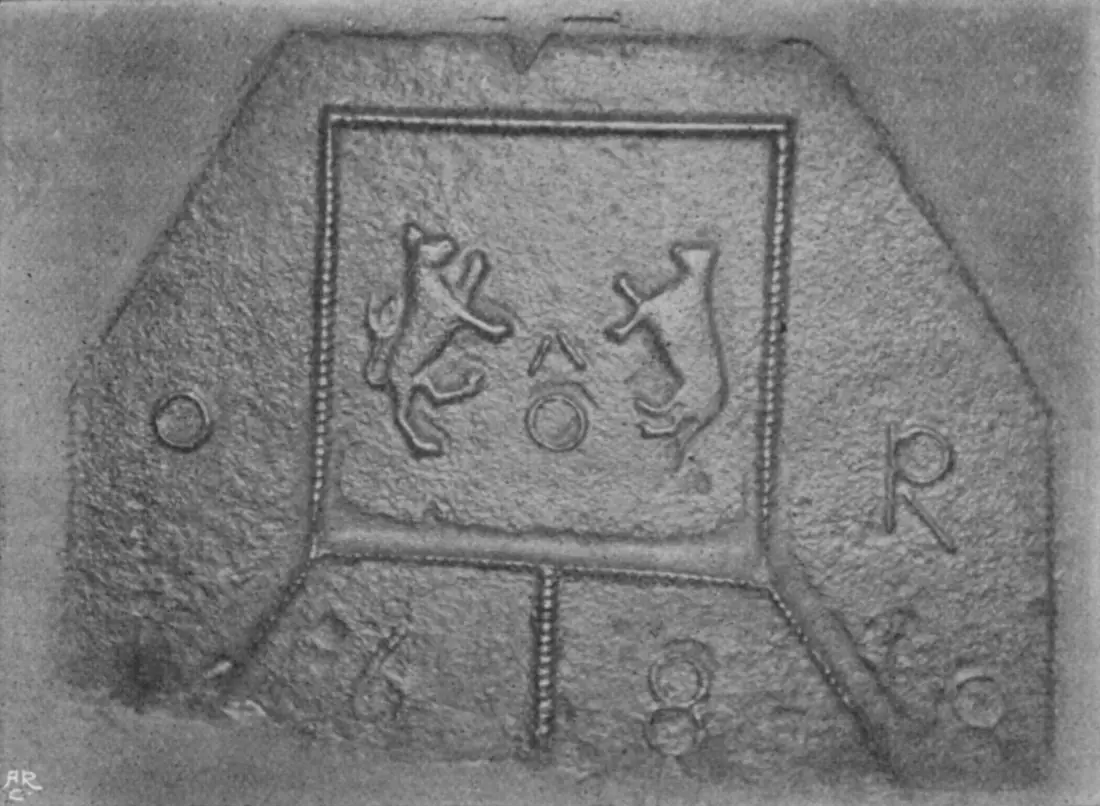
EXACTLY opposite Arigna, the northern terminus of the Cavan and Leitrim Railway—a railway by the way which this year has been absorbing a great deal of public attention in North Connaught—stands a pretty one-storied cottage. The cottage is about a hundred yards from the public road. On entering the door your attention is at once arrested by the object a photo of which is reproduced on this page. It is a metal casting of the arms of the O’Rourkes, the ancient chieftains of Breffni. The slab is built into the wall, and is quite flush with it.
It is of a large size—height, 1 foot 10 inches; greatest breadth, 2 feet 5 inches. The side of the square, in whose centre the heraldic animals in low relief figure, is 13 inches. The arms are plainly a lion (rampant) and a cat. They recall rhyming or jingling lines about the armorial ensigns of the Breffni chiefs that the Leitrim peasantry love to quote:—
“The rampant lion and the spotted cat,
The hand and dagger come next to that;
Those royal emblems may well divine,
The O’Rourkes belonged to a royal line.”
(From a Photograph by Downes, Drumshambo.)
On the slab there is no attempt at either hand or dagger. A probable explanation of their omission will be submitted later on in this paper.
Other armorial bearings of this very ancient Keltic house or of later branches of it may, however, be met with. They are two lions passant on a speckled shield, the crest a crowned helmet, out of the centre of the crown emerging a hand brandishing a dagger.
The ancient writers upon the science of heraldry take themselves wondrously seriously. In introducing us to their ponderously-worded volumes they endeavour to impress upon us that the chief object of their art is to perpetuate the memory of heroic deeds, or of deeds of supreme importance to the house or nation. This they try to effect by the aid of appropriate symbols charged upon or added to the coat-of-arms. Very aptly, too, do many armorial bearings do this. The crest of Hamilton of Manorhamilton—the powerful adversary of the O’Rourkes of Dromahair in the 1641 times, and a scion of the Hamiltons of Scotland—for instance, was a saw in an oak-tree surmounted by the equally puzzling motto of “Through.” It is said to commemorate Sir Gilbert Hamilton’s escape as a woodman in the year 1323. Sir Gilbert, when on a visit at the court of Edward II., fought a duel with Sir John Le Despencer and killed him. Forthwith he had to fly Scotland, which he did at top speed. Nearing the border the pursuit became hotter and hotter. So himself and his squire, as they were going through an oak-wood, disguised themselves and joined a party of woodcutters. They affected to be very busy sawing away at an oak when their pursuers came up with them. The squire’s nervousness almost betrayed them. But Hamilton called him to his senses by sharply shouting “Through” as the last shred of the oak was cut through. As the tree toppled over, the English knights passed unsuspectingly by. Resourcefulness and presence of mind in the midst of danger are, I presume, the lessons sought to be conveyed by the incident, or the special boast of the house of Hamilton.
The tradition about the cat on the O’Rourke shield is equally quaint.
Once upon a time and “long ‘go and long ’go it was,” to borrow the story-teller’s phrases, for it was away back in the tenth century of our era when the O’Rourkes were Kings of Connaught, a singular incident took place. Some one of the three chieftains of the clan, whom the Annals of the Four Masters mention as then Ard-righs of the province, was at war. Separated from his gallowglasses, and wearied out after many days’ and nights’ fighting and marching, he lay down to rest in an open glade. Thoroughly exhausted, he soon fell into a deep sleep and was in that condition when a spotted wild cat crawled out of the woods and came purring about his face. She awakened him, and only just in time to save him from the treacherous enemy that was stealing in upon him. This is the tradition. As to the truth of it
“I cannot say how that may be,
I tell the tale as it was told to me.”
No doubt it is quite as closely in accordance with facts as are other explanations of armorial devices; that, for instance, which makes known to us why a monkey figures as a supporter of the shield of the FitzGeralds, Dukes of Leinster. This is an equally pretty story. It does not now immediately concern us, and everybody has, in any case, heard of it.[1] As to the O’Rourkes, at all events, from that day to this, it is considered very unlucky for one of the name to kill or injure a cat. They may not know of the coat-of-arms and its heraldic intricacies, but they recognize the superstition, if such I may term it.[2] And hence, though with many the cat is a pet, in the humblest O’Rourke homes in Leitrim she is a prime favourite, and enjoys perhaps as much respect and consideration as did Juno’s geese, that, according to the Roman legend, in ancient days by their cackling saved the Capitol from the midnight Gauls.[3]
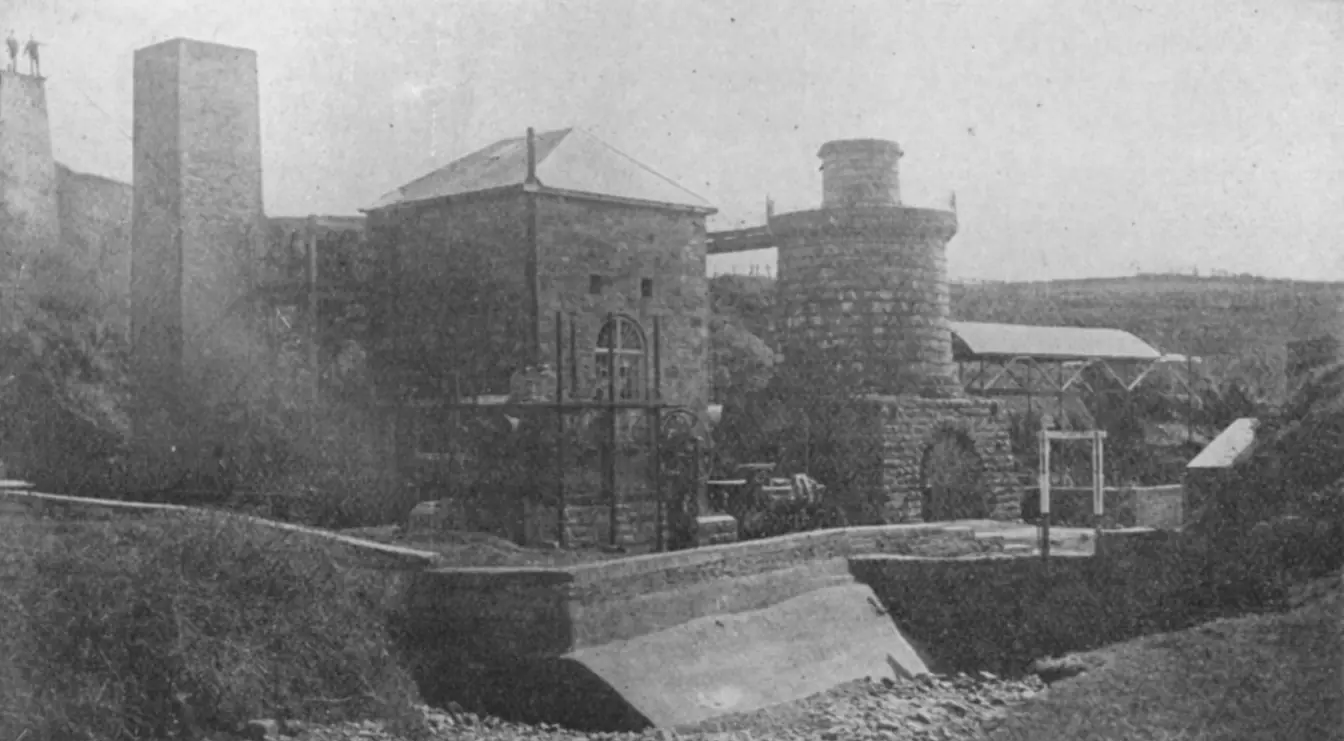
Tradition has it that the metal slab was cast on Furnace Hill. This hill, overlooking Lough Allen, lies a few hundred yards due north of the little town of Drumshambo, and a mile or two from the present location of the casting. The remains of the old furnace are still traceable. They are seen to be not upon the hill, but between the hill and lake. That circumstance, however, need create for us no difficulty as to the name of the hill. Some weeks ago, on a Saturday evening, I wrote to an old gentleman to kindly tell me the exact site, and how far it was from the town and lake. By return of post I was informed, “The old furnace is 540 paces from the first house in Drumshambo, fifty paces from the water’s edge at the southern end of Lough Allen, and sixty paces from the spot where the canal leaves the lake. I stepped it to-day on my way home from Mass.” I think, after this reply, we should be fairly well satisfied; we have its longitude and latitude.
The furnace, in construction, was similar to those found in all ancient Irish iron works. It was 3 feet square in the interior, and about 18 or 20 feet high. John Grieve, writing in May, 1800, states there were people then living who had worked at them.[4] The smelted iron used to be carried into the neighbouring village, and there forged into bars.[5] Most likely the iron-ore used came by water from Slieve-an-Ierin. This, indeed, is asserted by Griffith, who went over the ground in 1818, as well as by Guest,[6] who examined the district in 1804.[7]
Clayband iron-ore is to be found by the million tons north, east, and west of the head waters of the Shannon. So plentiful is it that in many places the beds of the river are laired with it, the fences of the fields constructed of it. Indeed, till well on in the nineteenth century there was no necessity felt for mining or quarrying it. Though used by the hundred tons, enough of the iron-stone could be gathered in the streams and fields to keep the furnaces all agoing.
Every geological map of Ireland indicates an area of about 300 square miles, with Lough Allen practically in the centre, as the mining district of Connaught.[8] It occupies considerable portions of the Counties of Leitrim, Sligo, and Roscommon, and also part of Cavan. The length from Doon mountain to Keadue is sixteen miles, and the greatest breadth from the Swanlinbar[9] hills to Killargue an equal distance. An imposing mountain, the highest in Leitrim, one whose summit rises to 1,922 feet above the sea-level, runs almost parallel to the south-western shore of Lough Allen, and quite close to it. The brown, towering mountain, and the little wooded, rather bare lake, form striking features of the rugged landscape. The name of the mountain is noteworthy; it is called Slieve-an-Ierin (in Irish, Sliabh-an-Iarainn). This signifies ‘The Mountain of Iron.’ “The very name,” says Dr. Joyce,[10] “shows that the presence of iron was known ages ago, when the name was imposed.”
Indeed, to the geologist especially, the whole region is one of fascinating interest, unequalled, I believe, in Ireland. Lough Allen itself is of mechanical origin. Most probably it was once a river valley continuous with the Shannon. It would be so again were its waters drained off. But in some far back geological age there was an “up-throw” on the south side, i.e. nature built up a solid wall of slate, sandstone, and limestone across the entrance to the Arigna river valley. Though much lowered by various geological causes, this barrier still remains; and behind it the waters of the Shannon are pent up.[11]
Coal is to be found everywhere throughout this region. Its presence is of very great interest. It is accepted as a proof that all Ireland was once possibly as rich in coal as England is; that the Coal measures once overspread all the country, now occupied by Carboniferous limestone, but were removed by denudation.[12] “What Ireland might have been,” states Hughes,[13] “if creative power had permitted her to remain as she was of erst, is, perhaps, difficult to determine.”
“If a traveller,” writes Hull (“Physical Geology and Geography of Ireland,” 2nd ed., p. 183), “visiting the regions of early civilization in Egypt, Syria, or Babylonia, observes the basement-walls of palaces or temples, and the foundations of arches or piers, while numerous blocks of hewn stone are thrown around it, it requires no history to convince him he may be standing on the ruins of a Thebes, a Palmyra, or a Babylon. He knows that where there were the foundations, there also must have been the superstructures. Now, the limestone is the basement of the Carboniferous superstructure; and the unvarying sequence of beds… leads us to this conclusion, that representatives of the upper members of the Carboniferous group were always originally present where the basal beds had been laid down; and that when the former are absent, it is only in consequence of denudation. … In several places… we find remnants of the upper Carboniferous strata which, owing to special circumstances, have escaped destruction, and, like solitary columns in the ruins of ancient temples, are monuments of the decay and wreck that has reigned around.
“In this way the little coal-fields of Castlecomer and Killenaule in the south, and those of Arigna, Slieve-an-Ierin, and Tyrone, are interesting as showing what kind of strata originally overlay the Carboniferous limestone between their widely separated positions.”
Coal, indeed, is being raised in Arigna at the rate of about 12,000 tons a year,[14] but no iron has been taken out of it for the last fifty years. Yet millions of tons of iron-ore are locked up in this beautiful region.[15] But though neglected and almost unknown now, they were not always so. They were not always allowed to lie idly there. The district once possessed for the Irish industrial economist a measure of the interest which it now displays in such full and overflowing measure for the geologist. It was one of the great Irish centres for the manufacture of iron.
In Arigna the metal was smelted from 1818 to 1836. The dismantled works are so extensive as to bear some resemblance to a little village. When in full swing they employed, according to those that saw them working, over 200 hands.[16] The circumstances which brought about the destruction of this industry at Arigna are very fully gone into by Griffith in his work already cited. They would not have failed to produce the same effect anywhere. These circumstances were referred to by Sir Robert Kane in his evidence before the Select Committee of Industries (Ireland), 1885,[17] in scathing terms.
Nor was the nineteenth century the sole time at which the mine treasures of Lough Allen district were unlocked. Sir Charles Coote is recorded to have carried on iron mining and smelting both in the Arigna valley and at Creevelea, County Leitrim, the most northern extremity of the Connaught Coal Fields, in the beginning of the seventeenth century. At the foundries attached ordnance were cast. Hence, anxious to hide from the Irish the secrets of the process, he employed only English and Dutch. Indeed, he is said to have engaged at one time in his different iron works throughout Ireland as many as 2,500 or 2,600 of these foreigners.[18] The reason assigned by Boate[19] for this exclusion of the Irish is not the one just adduced, but because, according to him, the natives were then considered the most barbarous natives of the whole earth, and “as having no skill in any of those things.” That country is to be pitied whose history is written by an enemy. The Creevelea and Arigna iron works were burnt down by the insurgents in 1641. They were “broke down and quite demolished,” Boate[20] says of them. They were re-started in the eighteenth century, but fell through from quite another cause. Fuel to work them failed. “In old times,” writes Kinahan, “but more especially in the sixteenth and seventeenth centuries, there was extensive mining, smelting, and milling of iron, which lasted till the woods were exhausted, the fuel being wood-charcoal. As the woods disappeared, the fires were put out, the last extinguished being Drumshambo, Co. Leitrim, in 1765.”[21] Surgeon-General Fawcett told the writer that he has frequently met with pieces of slag on the shores of Lough Allen, near his residence, and on breaking them up he found the wood-charcoal in the centre. Thousands and thousands of tons of the refuse were used in laying the line of the Cavan and Leitrim Light Railway in 1885 and 1886. It may be interesting to add that in 1788, twenty-three years after the last furnace-fire in Ireland went out for want of fuel, three brothers named O’Reilly started in the same district to smelt the iron with coal. This was the first attempt of the kind in Ireland.[22]
The importance of the last statement can hardly be realized by those that take but a small interest in metallurgy.
Coke and charcoal differ in this, that the former is obtained from coal, and the latter from wood, but by a perfectly similar process. The production of pig-iron by coke is so long the recognised method of procedure that we can hardly realize that its first adoption, or rather the discovery that coke was quite as effective as charcoal in calcining and smelting—that in its importance to the progress, to the industrial activity and wealth of Great Britain, it deserves to rank alongside of Stephenson’s improvements in the steam-engine. To make coke and try it, was but a little step. To us it would appear a quite obvious step, especially for men using wood-charcoal. Yet, to the people of those days, unsmitten as they were with the modern scientific enthusiasm for experimenting, it would seem it had never occurred to make it. It took over a century to get forward by just that one pace.
In the Life of Stephenson there is an instance of a similarly thoughtless dead stop.[23]
It is stated that in the early days of railway-making, matters were at a standstill for fully twenty years, because eminent engineers were of opinion that the locomotives would not grip on the smooth rail without cogs on both engine-wheels and rails. Accordingly, to contrivances to give the driving-wheel a firm hold of the track inventors addressed themselves, and wasted on them an enormous amount of time and ingenuity. But, at last, in 1817, Blachett and Headley tried it out, and discovered, to their surprise, that no such aids were required. These facts may be of much greater interest to the scientist, or to the anthropologist, than to the antiquary. But the fact that remains for us is, that for want of as much enterprise and initiative as is represented by the making of such an obvious experiment as substituting coal for wood, a whole industry was almost ruined in England, and was utterly destroyed in Ireland, the last furnace-fire in this country going out, as we have seen, beside the town of Drumshambo in 1765, with an abundance of coal of the best quality for the purpose, as authorities testify, to be had for the mere digging, within a mile or two of it. The extensive woods in the valleys around Drumshambo had at last given out, and the manufacture of iron had in consequence to be discontinued.
It is surprising that the use of coke was not known in Ireland before this time. Though the famous Dudley’s[24] successes, made first in 1619, in Staffordshire, were forgotten for a century, still, before 1740, Abraham Darby, of Coolebrook Dale, Shropshire, reproduced or re-discovered them. Not, as we have seen, till 1788, however, was it tried in Ireland; and it is on record that it was in France, not in England, the O’Reillys learnt of it. We have no such graphic details of the first smelting of coal by coke in Ireland at Drumshambo, as we have of its first production by the same material in England at Coolebrook Dale.[25] But, according to Mr. Whitworth, in his evidence before the Committee already referred to, Drumshambo pig-iron had gained quite a reputation before the century ended. The first ship built by the East India Company at Limerick was fitted out and fastened with iron from the O’Reillys’ furnaces. (Report of Industries Committee, p. 745.) The iron was described by Mr. W. Anderson, C.E., in 1856, as “of a density inferior only to Bowling and Devon, a tenacity superior to all, and a closeness of grain and structure nearly resembling the best iron England can produce.”[26] This has always been the character borne by Creevelea and Arigna iron. Creevelea farmers say of the iron manufactured there that horses’ shoes made of it never break, but wear out as thin as sixpences.
The metal-casting as a work of art cannot, I think, lay claim to any great distinction. It would be unfair, however, to expect any minute quarterings or other evidences of very cultivated skill from the Drumshambo foundry-men of the seventeenth century. Moreover, they cannot be supposed to have had any experience in turning out such special work—I am almost certain there is not another in the district or county—and the omission of the hand and dagger from the coat-of-arms would have been a considerable lightening of their labours. It is, however, I think, well and tastefully cast, and the moulding of the lines of the side of the square give it something of an artistic finish.
The raised Arabic figures across the face of the slab, 1, 6, 8, 8, determine, with fair certainty, the date of its being cast in Furnace Hill foundry. Instances of such metal slabs are, I believe, difficult to meet with in the United Kingdom. Still, in St. Leonard’s Church, in Bridgenorth, Shropshire, are a number of cast-iron monumental slabs of the same general character as the one under notice. They are in a good state of preservation, though one of them is even nine years older than that of the O’Rourkes, and dates back to 1679. Bridgenorth lies about twenty miles almost due west of Birmingham. It appears to have been at one time noted for its iron trade, and these “tombstones,” as an Irishman may venture to call them, are, without doubt, products of old blast furnaces in the vicinity.
The date of the casting, 1688, it will be observed, is exactly 100 years before the date of the first experiment in Ireland with coke, already alluded to. The casting was moulded quite beside where this important development of the industry was carried out. Nowhere else in Ireland, as far as I have been able to ascertain, was coke ever used in the preparation of iron.
The furnaces used when the casting was made were called bloomeries. This is a word not, as far as I know, to be met with in English literature. Still blôma is a good Anglo-Saxon term. It means ‘mass’ or ‘lump.’ It is a technical term in metallurgy, and all the lexicographers, from Johnson himself to Funk and Wagner, take care to define it. A mass of crude iron was sometimes named a bloom. Hence the curious term ‘bloomeries.’[27] Doubtless, the Drumshambo bloomeries, about which the Leitrim county folk still talk, were earlier editions of ones even nowadays in use in the Eastern States of America. For a description of the latter, I would beg to refer the reader to Turner’s work on the “Metallurgy of Iron,”[28] edited by Prof. Sir W. Roberts-Austen, K.C.B., F.K.S., 2nd ed., 1900. Bloomeries are, accordingly, seen to be far from obsolete. Though they suffer from many disadvantages, they have this marked feature, that they produce wrought-iron or steel direct from the ore in a single operation. This was the method invariably employed by the ancients. In Ireland there is no longer any smelting of iron. The latest published (1905) Blue Book on Mines and Quarries (“Part III.—Output, 1905”), shows that at the present day there is not a single blast-furnace of any description at work in the country. The last was extinguished at Creevelea in 1858; and though since then two great efforts were made to revive the Creevelea industry, they proved complete failures. Dr. Boate’s “Natural History of Ireland” was written more than 260 years ago. In it he tells us that iron was then manufactured in considerable quantity, and much of it exported to London. Not a cwt. is manufactured now. Further, though iron ore is known to exist, and by the million tons, in as many as twenty-four out of the thirty-two counties of Ireland,[29] not a single ton was produced, as the same authorities show, in 1904, 1903, or 1902, nor, I believe, for many years before that, except in County Antrim. Even in that county the output for 1904 was barely 91,215 tons. Sad to say, the localities of some of the ancient Irish mines are, indeed, quite unknown, and the exact position of many others uncertain.[30] Apart, therefore, from any historic value it may possess, the relic whose photo is here reproduced will be allowed to be interesting on one or two further counts. It is a specimen of a lost Irish art—the manufacture of iron.[31] It is a product of the seventeenth-century Irish furnaces, and of the rude foundries attached to them. And it was turned out in that rich mining district of North Connaught, where, as well as can be ascertained from tradition, or from available records, the metallurgy of iron attained in this island, most likely its earliest, and certainly its highest development. Of such foundries’ outputs, I make no doubt, many interesting specimens still exist here and there in other parts of Ireland. I know of but another one. It is the back of a fireplace from one of the rooms of Sir Frederick Hamilton’s castle of Manorhamilton. After the burning down of this castle in 1641, this metal plate was taken away, and it is now in the possession of Richard Earls Davis, Esq., J.P., of Lurganboy, beside Manorhamilton. It is of a well-made diamond pattern, and is somewhat larger than the casting under discussion. As likely as not, it was turned out at Sir Charles Coote’s furnaces at Creevelea; or possibly at Garrison, County Fermanagh, on the very verge of Leitrim, about eight miles from Manorhamilton Castle. Here, too, there were iron-works in the beginning of the eleventh century. The burning down of them in 1641 is the very first entry in the Diary of Sir F. Hamilton, the first recorded exploit among his many raids and burnings. But I cannot see that anything beyond mere conjecture can now be advanced as to its origin.
The O’Rourke specimen too, one may venture to say, is, in one respect, almost unique.
Last place in Ireland where Iron has been manufactured.
(From a Photograph by the Rev. Joseph Meehan, c.c.)
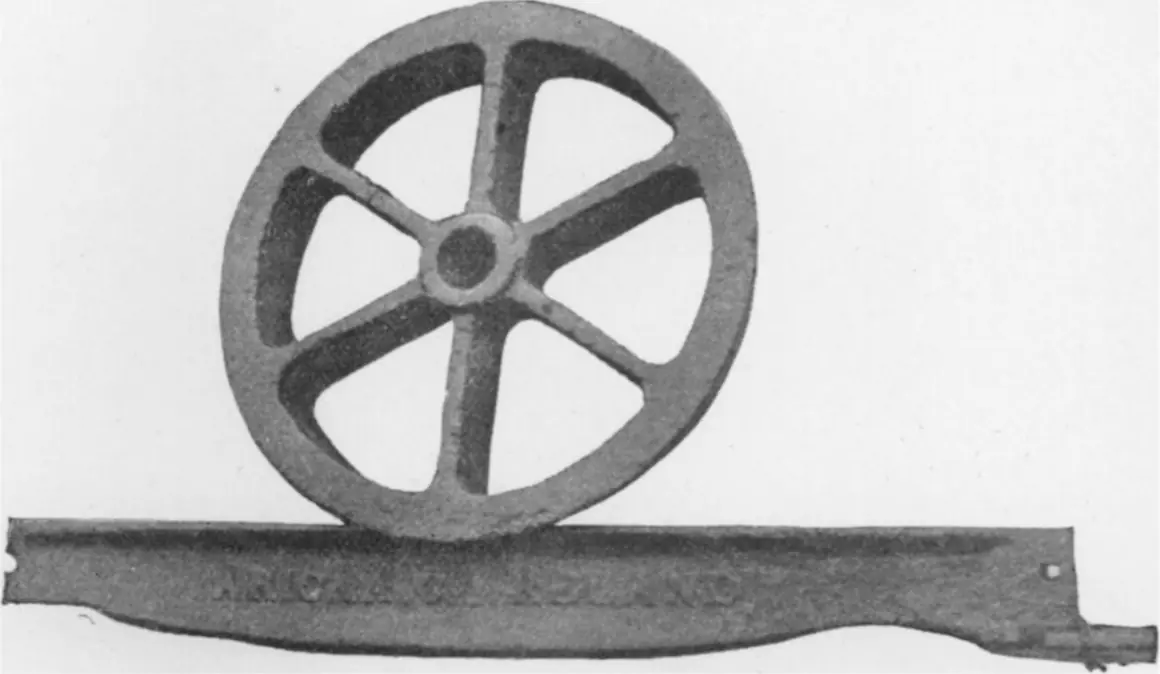
Except this slab, there remains, I fear, no other relic of Drumshambo handiwork[32] in iron. True, indeed, you will be told that in farmers’ homes around Lough Allen there may be found immense cauldrons which have been in use ever since the bloomeries were shut down. But, though years on the quest, I have never succeeded in discovering one. In any case, if there be, it is much more likely that the articles belong to the post-bloomery age of Arigna iron-mining, and the modern epoch there inaugurated, and Creevelea, not far from it, only excepted, there alone, I believe, in Ireland carried out, of smelting with coke. During its flourishing period, from 1818 to 1836, all kinds of domestic utensils were moulded at Arigna, and sent down the Shannon all along to Limerick. In pattern they were rather heavy and coarse, but they atoned for this by lasting a lifetime. A gentleman of the district told the writer a couple of months ago that he knew of a cauldron in a friend’s house which was in constant use for upwards of eighty years. It came to grief, unfortunately, towards the end of the last century. It was so heavy that a man could hardly raise it. I am afraid, therefore, that specimens of even Arigna castings are now as scarce as those of the older Drumshambo iron works. I have seen but one or two of which I could at all feel certain. In the office of the Arigna Coal Company there are two metal rails which belonged to the old metal tramway and the flanged iron wheel of a low lorry made to run upon them. They were constructed at Arigna about 1820. The mantelpiece too, a plain metal slab, is a product of the foundries. The rails differ from those now in use in having a simple arrangement for locking them into one another. The inscription, “Arigna, Ireland,” suggests they were also made for exportation. A very intelligent old resident of the place informed me that in 1857 or 1858 he saw carted away thousands of these rails, which had been used in the tramway, as it was called, connecting the iron-mines with the furnaces, besides wheels and manufactured pig-iron. The carting went on for months.
(From a Photograph by Downes, Drumshambo.)
At Annadale, a very beautiful residence situated four or five miles as the crow flies east by south of Drumshambo, there is another large slab of cast-iron, the surface of which is about 27 inches by 18. It is stamped with the date 1692. The unit figure is a good deal worn away, but there can be little doubt of its being a 2. As Annadale is so near Drumshambo, one is prompted to think that this slab is also of Slieve-an-Ierin iron and was moulded at the Furnace Hill foundry. But tradition disproves this. This casting, too, carries with it an interesting piece of Leitrim family and local history. It would be a pity were it left to perish.
In the beginning of the last ten years of the seventeenth century, three brothers belonging to a wealthy Derbyshire family of the name of Slacke came over to Ireland. They came in the wake of some of their relations who had arrived earlier and were succeeding in the north. The Rev. Robert Slacke, who, by Letters Patent of James I., was appointed Incumbent of Maher-Culmoney, in the diocese of Clogher in 1619, and the Rev. James Slacke (or Slack), who was the first Protestant Rector of Inniskeane, or Enniskillen, were of this earlier migration. Not unlikely they came over as chaplains with King James’s “Plantation.” The latter-named clergyman lived at a place called “Antony on the Hill,” in Enniskillen, and was blessed with the assistance of a gentleman whom the Ulster Visitation Book of 1622 quaintly describes as a “sufficient curate.” The Rev. Mr. Slacke was Rector of Enniskillen from 1622 till his death, which took place in 1634. Besides Enniskillen, he held the Incumbency of the neighbouring parishes of Kinawley and Killesher, in the diocese of Kilmore. Rut he resided in Enniskillen. He it was that, doubtless assisted by his “sufficient curate,” erected the old church of Enniskillen. A stone in the church tower bears the date 1637 chiselled in it; and it is inferred from this that the tower was erected in that year. The church itself is supposed to have been completed some years previously. In 1612, William Cole, ancestor of Lord Enniskillen, had been directed to give a place for a church and cemetery there. Rut though it would seem to have been begun, it was not at all events completed in 1622. The Visitation Book of that year says of it: “It goeth slow forward, as all works of that nature”—no high compliment to the Enniskilleners of those days. In 1622, it is recorded, there was an old church, which we take it was an “appropriated” one, in ruins on an island near the town.
Of the three Slacke brothers that simultaneously came to Ireland “to push their fortunes” shortly after 1690, John settled in Monaghan,—in Dublin, and William, styled in old Chancery records “Captain William,” in Leitrim. The latter’s branch of the family alone survives. Consequently, its present representative, Sir Owen Randal Slacke, C.B., is the head of the Slacke family in Ireland.
An old record of about 1695 mentions Captain William Slacke both as having “lately come to live in Ballinamore, County Leitrim,” and as receiving a large sum of money from England. He was very wealthy, and purchased the estate of Bellscarro (Drumrahonoughter and Drumramonaghter), in the barony of Mohill. Soon afterwards he moved to Kiltubride, which he had just obtained. Kiltubride was church property. The name signifies the church of St. Brigid’s well (Kill-Tubber-Bride). This ‘holy well’ is still to be seen. It is in the yard of Kiltubride House. The old house, originally a monastery, was pulled down; but the ruins of its extensive vaults, as well as part of the walls of its church, still remain. Kiltubride has been renamed Annadale. This was done in memory of “Angel Anne Slacke,” a remarkably energetic and religious-minded woman, who died there on the 15th November, 1796, at the early age of forty-eight. Her “Journal” and some of her writings are still preserved. They are of much literary worth.
Miss Helen A. Crofton, who has compiled from all possible sources the records of “The Slacke Family in Ireland,” gathers from old Chancery Bills, that “in February, 1695, William Slacke, John Skerret, and Joseph Hall entered into an agreement concerning the erection of certain ironworks in Leitrim,” viz. at Dromod and Ballinamore. These agreements were renewed from time to time from that till 1713. At that date the records cease. It is accordingly surmised that then, or about then, these iron works were finally given up. At the present day of their products there is known to exist but one solitary specimen, the slab above mentioned with the date 1692. It is built into a wall at Annadale. Captain William Slacke is recorded to have brought the casting with him to Kiltubride on taking up his residence there. The slab is therefore quite as unique as is the one of the O’Rourke coat-of-arms.
Skerret and Hall, above mentioned, are considered to have come across from England with the Slackes. Both in Monaghan and Leitrim they settled near them. As far as I have been able to ascertain, these families are now extinct. They were no great favourites in the country. A quaint old rhyme, which will hardly go well in print,[33] hurls maledictions at all three of them—Slackes and Skerrets and Halls—with very commendable impartiality.
On the Slacke escutcheon is emblazoned a snail and the motto: “Lente sed certe.” This discloses an unacknowledged principle in heraldry hardly in keeping with its dignity—simply punning. The original motto everywhere survives; but in Ireland the crest has been changed to the common-place lion. In England, where the family is now widespread, it is still a snail.
Across the face of the metal slab are in Roman characters the initial letters of the name Owen O’Rourke (O. O. R.). Owen is a name to which the chieftain family of Breffni were as partial as were the Tudors of England to Henry; as were the Bourbon monarchs of France to Louis. An Owen, fourth or fifth of the name—Father Meehan[34] calls him Sir Owen—ruled in Dromahair in 1641. This can be readily proved. What is known as the Diary of Sir Frederick Hamilton,[35] of Manorhamilton, records martial displays made by this chief before the castle of this tyrant, the Tamerlane of the west, as Dr. O’Rorke calls him in his “History of Sligo”—and North Leitrim tradition, I can personally vouch, fully justifies the title[36]—on January 6th, January 30th, and February 4th, 1641. Assisted by his allies, he commanded on these occasions from 600 to 1500 or 1600 men.[37] The Appendix also contains a letter to Sir Frederick from Sir Robert Hannay and his friends, who were prisoners in Dromahair. The letter is undated, but Sir Frederick’s reply, characteristically ruthless, is dated “Castle Hamilton, Jan. 16th, 1641.” The insurrection resulted both in the destruction of Manorhamilton Castle, on the one side, and the expulsion or confirmation[38] of the expulsion of Owen from Dromahair, on the other. The latter made a strenuous effort to recover his lordship and the lands of his ancestors in 1642. But at the close of the Cromwellian war the O’Rourkes were again involved in the general confiscations.
On being driven from the banks of the Bonet, Owen retired to a picturesque spot on the shores of Lough Allen. The foundations of his residence are still traceable. It was situated at Lecarrow (renamed Strandhill), about three miles south of the village of Drumkeeran. The modern mansion of Surgeon-General Fawcett occupies a spot just alongside of its site, and a useful boat-quay, opened by Earl Spencer during his vice-royalty, and called after him Spencer harbour, is at the lake below it. Here most probably he died. Jones’ Commission was appointed to inquire into some of the acts of the rebellion of 1641, and he was summoned to give evidence. A copy of the report is preserved in the Library of Trinity College, Dublin. A learned gentleman, who examined it, informed the writer that O’Rourke, who displayed the greatest ability in his examination, gave his address as Lecarrow, Drumkeeran.
As proved by its date, 1688, it is much more likely that the casting was made not for Owen (or Sir Owen) of those stirring 1641 times, but for a son of his, another Owen. I would venture to advance the theory that it is a monumental slab like those of St. Leonard’s Church, in Bridgenorth, though both tradition and the manner of its preservation are against it. If it be, it would at once settle the date of the death of the 1641 Owen as 1688, not in itself an improbable supposition. There is mention of his brothers, but never of his children, in Hamilton’s Diary; and hence, I take it, he was probably at the period a young man, and it would not be surprising to find him living for forty-seven years afterwards.
Owen, junior, lived at Cartron Beg, on the shores of Lough Allen, and hence within a few miles of the old Drumshambo bloomery. The intelligent old gentleman who gave me, with such precision, the longitude and latitude of the ruins of this bloomery also informs me that “the location is in County Leitrim, about 200 yards from the water’s edge and about 50 yards north of the stream that separates County Leitrim from County Roscommon.” Anyone passing along the county road from Manorhamilton to Carrick-on-Shannon can easily discover the spot; but there is no trace of the house. Not a stone upon a stone remains of it. It was for this Owen that Carolan, who was a frequent and welcome visitor at Cartron Beg, composed his “Dirge on the death of Owen O’Rourke.” And it was for his wife Mary MacDermott he composed the song, said to have been extremely beautiful, “Mhaire-an-Chuil-Finn,” or “Fair-haired Mary.” According to Hardiman in his memoir of Carolan, the latter was composed in the garden of Greyfield House, beside Keadue.[39] The old mansion still remains. Henry MacDermot Roe lived there at the time. When Carolan arrived, he found him entertaining Owen O’Rourke and his wife, Mary MacDermott. The bard at once retired to the garden, and in a short space presented himself before his host, and sang this song in honour of the guests. This, as well as many other priceless gems of the last of the bards, is, I very much fear, irretrievably lost to us. Carolan spent much of his time with the Leitrim peasantry, and composed for them many charming airs. They were handed down traditionally. But until within the last few years no serious effort, as far as I am aware, was ever made to collect them. Singular to say, it was from a Dublin gentleman the writer obtained one of those traditional Leitrim airs, “The Hurlers’ March,” and he took it down from a Leitrim man in Cork. Some days ago I went to see an old neighbour who has a great taste for music. He has many a rare and curious air, and I asked him about the song “Fair-haired Mary.” “When I was a boy,” he replied, “I heard it often; but I do not know a word of it now. If I had taken half as much interest in such matters then as I would now, I could have known very many interesting airs.”
The present owner of the casting of the O’Rourkes’ coat-of-arms is Mr. Denis O’Rourke, of Arigna, a very respectable retired National School teacher. He gave me very fully the particulars of how the heirloom came to him, and a brief résumé is worth recording.
Owen O’Rourke, junior (v. Appendix), who must have lived well into the eighteenth century, died without issue. Most probably it was under his supervision that the casting was moulded. On his death the “arms” passed into the hands of his nephew, Con, son of his brother Hugh, and namesake and grand nephew of Con of Castle Car, beside Manorhamilton, who was sheriff of Leitrim in 1641, but was afterwards captured and hanged by Sir Frederick Hamilton from the walls of his castle, on January 2nd, 1641.[40] Con the Younger lived at Grouse Lodge, on the verge of Drumkeeran. This place was called “Alla Cuinn,” or “Con’s Hall,” down to a generation ago. Even yet it is so termed by Irish-speakers. Con the Younger had four children, one son and three daughters. The son, Denis, died young about 1780, leaving five young children. Ellen, a sister of his, remained unmarried, and died at a very advanced age about the year 1820. It was she that preserved the old metal slab. She was god-mother of another Con O’Rourke, a grand-nephew of hers, and to him she bequeathed it. Con the Third went off to Galway, leaving it behind him in his father’s house. The gentleman last named was grandfather of the present owner, Denis O’Rourke, to whom it has descended. The person last mentioned, I may add, visited his uncle, Con O’Rourke, in Galway in 1845, the year before his death, and from him he obtained both confirmation of the history here detailed and a vast amount of interesting particulars regarding the later fortunes of their family. Mr. Denis O’Rourke has a son and daughters and cousins by the score, so there is small danger of the ancient family dying out.
The surname O’Rourke or Rourke, with a dozen variations in the spelling of each, is, as one would expect, Keltic. Art, son of Rourke, is said to have been the first to assume it.[41] It is found in every province in Ireland,[42] and most likely in every county. In Leitrim, though, before the time of Queen Elizabeth, the territory of which the county formed the main part was often termed the “Country of the O’Rourkes,” it is not so very common, and is not among the first twenty commonest names belonging to that county. Leitrim, it should be observed, was called the “Country of the O’Rourkes,” not from the number bearing the name, but because of the power and sway of the chieftains. Indeed, John Dymmok, writing about the year 1600, says of Leitrim:—“It hath no principal person inhabitinge there but O’Rurk and others of his name, and freholders wholly depending upon him.” “This county,” he said a little before that, “containeth all O’Rurkes cuntry, called the breny O’Rurk.” But though not particularly numerous in Leitrim, there are, adopting Matheson’s principles of computation, as many as about 8,500[43] individuals of that surname in Ireland. Of these more than three to one write it in English fashion, without the prefix O. In Leinster, in Dublin especially, where they are most plentiful, it is the exception, or at least was the exception ten years ago,[44] to find the O used. Even in Connaught it is more usually dropped or not assumed. Whether they be Rourke or O’Rourke, however, I should no more wish to insinuate that all those thousands scattered throughout Ireland are of the blood of the “proudest family that ever walked the earth,”[45] than that every O’Brien is a lineal descendant of Brian Borumha, King of Munster. However, though fallen on evil days, it is quite possible that some, even beyond the confines of Leitrim, may be; and if so, it would be well for them to keep up the family traditions and the spirit of honour which they should inspire. Not undistinguished families indeed in Galway and Down, as well as in Norfolk in England, in Spain and in distant Russia, claim kinship with the princes of Breffni. As to these, they have now leisure to look into these matters, and education enough to value them. Those of the first-mentioned county, though their claim may be allowed, are not, however, descendants of the Con O’Rourke who, as I have mentioned, lived in and died in Galway. They spring from a Rev. Mr. O’Rourke, a gentleman who for some time towards the end of the eighteenth century officiated in the neighbourhood of the parish of Killenummery (County Leitrim), and who, on conforming to the Established Church, obtained a benefice in the county named.
Sir George Maurice “O’Rorke,” who was knighted in 1880, is a grandson of this conforming minister. In the House of Representatives of New Zealand, Sir George has been five times elected Speaker. He was for twelve years Speaker of the Auckland Provincial Council, and was a Member of the New Zealand Ministry from 1872 to 1874.[46] His career deserves mentioning, because it goes to show that the O’Rourkes were men of brains. His, too, is but an instance of the many men of ability who in their own land would most likely have lived unprized, and have lived unhappy as well, blighted by Swift’s curse on the Irishman of genius and of honour; but who, having bid good-bye to its shores, flourished exceedingly under other skies. In Russia, some of the O’Rourkes have been much more distinguished.
To the country just named the O’Rourkes, indeed, seem to have been partial, as were the Taafes to Austria, the MacMahons to France, and the O’Donnells to both Austria and Spain. Driven from their own country, they found refuge in these. In our days some of their descendants have been seen guiding the destinies of their respective favourites.
Whether Sir George has or has not the honour of being of the proud house that once ruled from Bundrowes to the gates of Kells, the family, as is evident from what has been written, is, I am pleased to say, far from being extinct in Leitrim. Though their ancient glory be departed and a stranger lives in Dromahair, though fallen, comparatively speaking, on evil days, and sometimes on evil tongues, there are to be found by the dozen men who might, if they troubled about it, trace their descent from Sir Owen of Dromahair, and Brian Ballagh of martial fame. At least a score of such are among my acquaintances, plain, simple, peasant folk like the rest of us.
In the tenth century, according to the “Annals of the Four Masters,” three of the princes of Breffni were kings of Connaught. “O’Rurk and O’Connor Don,” writes besides Dymmok in his Treatice of Irelande already quoted, “have in their severall antiquities been Kings of Irelande.” It is accordingly plain that there is ample justification for the oft-claimed distinction that in the veins of the Irish peasantry pulsates the blood of kings.
As to one branch of the family, it is interesting to add that the old metal casting I have tried to describe has been a great means of keeping alive the traditions of the family, every son remarking it, and asking his father what it meant, and how he became possessed of it.
APPENDIX.
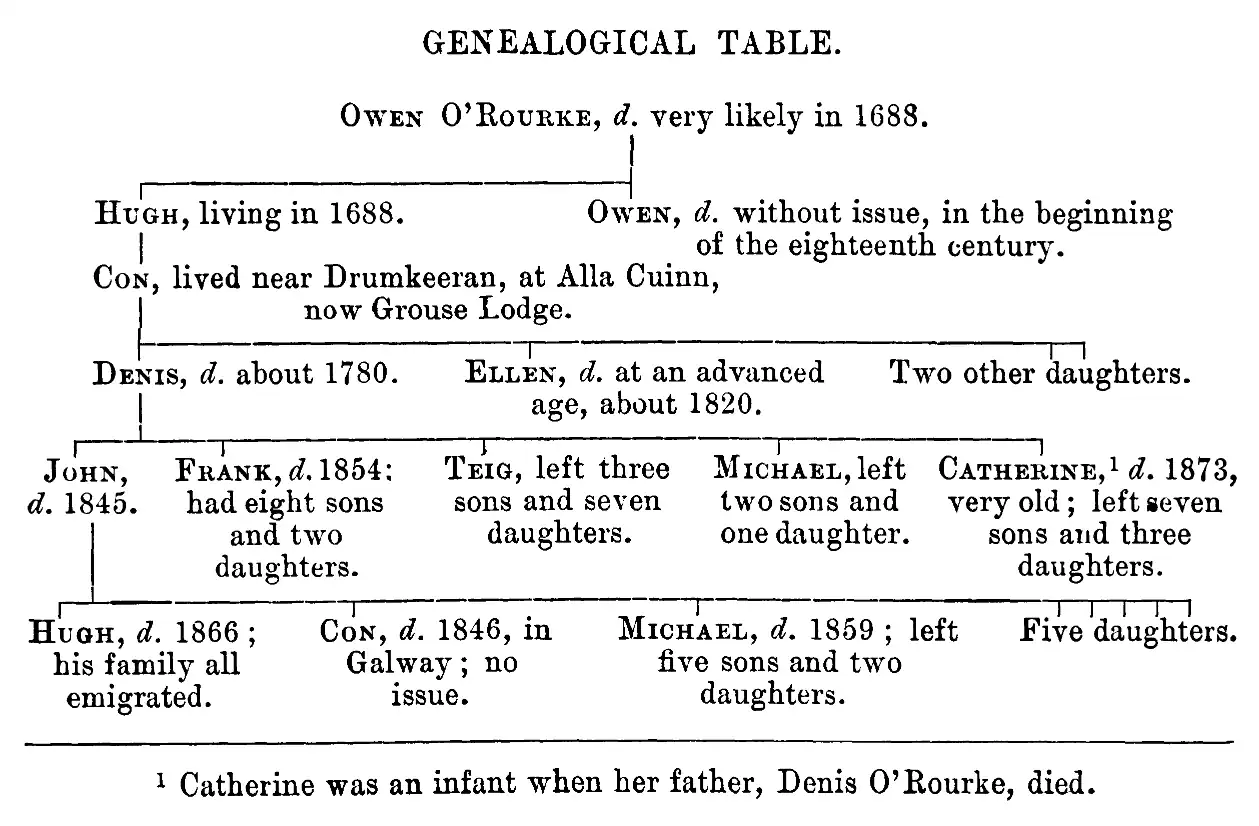 I try to give a Genealogical Table of the O’Rourke family, as far as I have been able to make it out, since the time of the last Owen of Dromahair. Though much care has been expended on the drawing up of this Table, I am quite ready to admit it may contain mistakes. The information, however, though traditional, is in most points corroborated by independent documentary evidence. All mention of living persons is excluded.
There is some doubt as to the immediate ancestors of the Owen O’Rourke above mentioned. His father, all authorities agree, was Tiernan Ban, or ‘Fair-haired Tiernan.’ But, according to the Four Masters, Tiernan Ban was the son of Brian, son of Owen O’Rourke, while, according to O’Clery’s and MacFirbis’s Genealogies, Tiernan Ban was the son of Owen, the youngest son of Brian Ballagh. In the first case, he would be a brother of Brian-na-Murtha, or ‘Brian of the Ramparts’; in the second case, he would be his nephew, and first cousin to the famous Brian Ogue.
Owen of Dromahair, whose name heads the following Table, had at least two brothers. In Hamilton’s Diary (so called), Brian Ballagh and Con (or Con Tiernan), of Castle Car, are mentioned as so related to him. The latter’s castle, at the entrance of the beautiful valley of Glencar, was plundered by Hamilton’s troopers, as is related in the same Diary, and he himself eventually captured and hanged by Sir Frederick in 1641.
Notes
Read March 27, 1906.
Footnotes:
- A much less romantic explanation of the coat-of-arms of the Earls of Kildare is insisted on by Sir William Betham in his “Irish Antiquarian Researches” (Part I., p. 227. Dublin: W. Curry, Jun., & Co., 1826). According to this learned gentleman, “the supporters of the house of Kildare were originally two lions.” But so roughly were they sketched or painted, that they came to be taken for monkeys. Sir William is indeed honest, dispassionate, and painstaking, possessing the true spirit of an antiquary: but it would be a pity, I think, if he would oblige us to believe him, and could induce us to substitute the commonplace for the romantic. I may point out that in the earlier pages of the same volume, he demonstrates that he had thoroughly convinced himself that there was no evidence for the mission of St. Patrick to Ireland. This should be sufficient to shake our confidence in his opinions. With Archbishop Healy’s or Mr. Bury’s exhaustive works before us, or even in the light of the opening pages of the last number of this Journal, we can scarcely now maintain that he is at present to be regarded as in the first rank of authorities. Or, perhaps, it should rather be said, here is a good opportunity for estimating the vast advances made, in the fields of research, since 1826—an instance of the vast amount of knowledge on historic and pre-historic subjects acquired and accumulated since those days. A large proportion of it must, undoubtedly, be set down to the credit of the painstaking efforts of members of our Society.
The story of the ape snatching the child from the cradle and carrying it aloft to the top of the castle, was also told of Thomas Nappagh (or the ape), the third Earl of Desmond. The Desmond crest, too, is a monkey. Betham, in accounting for it, is equally matter-of-fact. He maintains it was at first a lion passant, but was “ignorantly changed to a monkey.” He acknowledges that in this case the ape tradition pre-dated the transformation, but holds that it assisted the process. He thus barely stops short of asserting that the tradition was invented to explain the crest—not the crest devised to perpetuate the tradition. [↵] - For another pretty legend about the O’Rourkes of the olden days, I would refer the reader to Dr. O’Rorke’s “History of Sligo,” vol. ii., p. 308. [↵]
- Miss Ellen O’Rourke (r. Appendix), who died about 1820 at a very advanced age, let this feeling of affection grow upon her, and in the end had a whole barnful of pussies. If report speaks true, she must have been quite as much attached to them as was Miss Charlotte Raine, of Woodstock, Oxfordshire, who died on June 19th, 1894, to her pets. For the rather amusing provisions of the latter lady’s will relating to these cats, I would refer the reader to the “Times” of September 28th, 1894, p. 8, or to Vaughan’s “Thoughts for all Times,” p. 407, which quotes them. [↵]
- Griffith’s “Geological and Mining Survey of the Connaught Coal District,” Dublin: Graisberry and Campbell, 1818, p. 83. [↵]
- Ibid., p. 58. [↵]
- Ancestor of the present Lord Wimborne. [↵]
- Griffith, Appendix II, p. 93. [↵]
- V., e. g., Hull’s “Physical Geology and Geography of Ireland,” 2nd ed., 1891, frontispiece. Or v. Griffith’s “Geological and Mining Survey of the Connaught Coal District”: Dublin, 1818, Map, at end. [↵]
- Swanlinbar, the frontier town of the Connaught coal-fields, has the distinction of having a name as curious in its derivation as any place-name in Ireland. No mere philologist need attempt its explanation. It is this: some two centuries ago, according to local tradition, three wealthy miners, a Mr. Swan, a Mr. Ling, and a Mr. Barr, erected in the place iron-works which once promised to grow into a thriving industry. Their three names are combined in Swan-lin-bar. The place indeed has the name as yet, but the industry, the more important matter, is long gone, and quite forgotten. Looking at a geological map of England or of the United States, one observes that the great towns have sprung up on the spots rich in their coal and iron deposits. With the supplying of the essential of good transit facilities, under favourable circumstances, it might be hoped that Lough Allen district would yet develop into a second Pittsburg. Swanlinbar from time immemorial has been famed for its mineral springs. [↵]
- Philip’s “Atlas and Geography of Ireland,” by Joyce (Leitrim). [↵]
- Hull’s “Physical Geology and Geography of Ireland,” 2nd ed., p. 227. [↵]
- That it was by denudation is also the opinion of Professor Grenville Cole. The rival theory that they were never deposited, i.e., that Ireland was under water at the time the coal-beds were laid down in England, has at present but few supporters. [↵]
- “Geological Notes of Ireland,” by William Hughes, 4th ed., p. 73 (Dublin: Gill & Son). [↵]
- Mines and Quarries, General Report and Statistics for 1904. Part III.—Output, p. 178. [↵]
- In 1890 Professor Hull made a careful survey of a small corner of it at Creevelea, and estimated that it contains at least 7,840,000 tons. [↵]
- Report of Industries (Ireland), Appendix No. 10, p. 747. [↵]
- Questions 3087-3090. [↵]
- Report of Industries (Ireland), Appendix No. 9, p. 745. [↵]
- “Nat. Hist. Ireland,” p. 69. [↵]
- Boate’s “Nat. Hist. Ireland,” p. 72. [↵]
- “Economic Geology of Ireland,” p. 72. [↵]
- Kinahan, “Economic Geology of Ireland,” p. 72. Griffith writes, p. 59:—“The Arigna works being the only ones ever erected in Ireland to smelt iron with pit-coal, attracted great attention, and their want of success has been, in consequence, deeply felt.” This was written in 1818. He goes very minutely into the causes of failure. [↵]
- V. also Rankine’s “History of the Steam-Engine.” [↵]
- Natural son of Edward, Earl of Dudley. His works are said to have been destroyed by a mob, instigated, it is thought, by the iron-masters who used charcoal. V. Griffith, p. 59, note. [↵]
- Dr. Percy, who fully recognised its epoch-making importance, thus described it:—“Having thus made a good stock of coke, he (Darby) proceeded to experiment upon it as a substitute for charcoal. He himself watched the filling of the furnace during six days and nights, having no regular sleep, and taking his meals on the furnace-top. On the sixth evening, after many disappointments, the experiment succeeded, and the iron ran out well. He then fell asleep on the bridge-house at the top of his old-fashioned furnace, so soundly, that his men could not wake him, and carried him sleeping, to his house, a quarter of a mile distant.” (Quoted by Turner, p. 11). Though we have many experimentalists in our days, we have none more earnest than Abraham Darby. He fully deserved the success that rewarded him. [↵]
- R. D. S. Journal, vol. i., p. 327. [↵]
- The spelling of this word is as variable as that of the proper name ‘O’Rourke’ itself. Many authorities favour ‘bloomry.’ Webster gives ‘blomary,’ or ‘bloomary.’ Johnson gives ‘blomary’ alone. Turner, in the standard work quoted later, always spells it ‘bloomery.’ Funk and Wagner’s Dictionary has ‘bloomery,’ but gives as variants ‘blomary’ and ‘bloomary.’ The two last-named authorities are as good as any. We prefer to follow them. [↵]
- Page 246. London: Griffin & Co. [↵]
- For list v. Kinahan (already quoted), pp. 40–51, and Report of Industries (Ireland), Appendix No. 27, p. 829. [↵]
- Kinahan, p. 40. [↵]
- Creevelea, a district of the parish in which the writer officiates, is the last place in Ireland in which iron was obtained. Some successful experiments, but successful only as experiments, took place there as recently as 1898. Commercially, they cannot succeed until a railway connects the mines with the nearest port. There remain half a dozen sheets of iron which were then smelt and moulded. [↵]
- On the gates of the barracks in Drumshambo there are also two pier-heads, and on a sidewalk in the street an iron slab which does duty as a flagstone. But these are of the plainest description of work. [↵]
- “Slacke and Skerret and Hall,
The d—l take them all!
Skerret and Hall and Slacke,
The d—l take the pack!
Hall and Slacke and Skerret,
The d—l them ferret!” [↵] - Franciscan Monasteries, p. 86. [↵]
- I have authority for stating it was not written by Sir Frederick, but by one of his troopers, Sergeant Scott. This is borne out by the internal evidence. [↵]
- Cf. Lecky, “History of the Eighteenth Century,” vol. i., p. 84. Strafford, in his letters, states his proceedings did not admit of defence. [↵]
- “January 13 (1641). A party is sent towards the Castle of Dromahaire, where their great Colonel, Owen O’Rourke, with all his strength lay; yet we burned many goodly houses and haggards of corne, within a mile of the castle, burning all within five miles forwards.”—From Diary above mentioned. [↵]
- It was Bryan Oge O’Rourke that first lost Dromahaire. He had to leave it in 1602. He then went to live to Mayo. Owen, as the diary shows, must have resumed possession. [↵]
- In connexion with Leitrim family history, it may be of interest to add that for generations past Greyfield and its surrounding acres belong to representatives of another ancient Irish house, the O’Donnells of Tyrconnell. One branch of this family has been domiciled in Leitrim (at Larkfield, Manorhamilton) since the time of Hugh O’Donnell, Count of the Holy Roman Empire. On the death of the last of the male descendants of the Earl of Tyrconnell, Count Hugh was commonly styled Earl O’Donnell. According to Betham (in his work referred to in a previous note, p. 188) Earl O’Donnell was a general in the service of Maria Teresa of Austria. His grandmother was Catherine O’Rourke, doubtless one of the Breffni family. Earl O’Donnell was descended, through Hugh Boy, from Sir Neill Garv O’Donnell, who was knighted by Lord Mountjoy in 1602. The present representative of the Leitrim branch of the O’Donnells, John O’Donnell, Esq., J.P., is fourth in descent from “Earl O’Donnell” above mentioned. [↵]
- Diary already quoted. [↵]
- O’Hart’s Pedigrees, First Series, p. 158. [↵]
- Matheson’s Special Report on Surnames in Ireland, 1894. An appendix to the Annual Report of the Registrar-General. [↵]
- Matheson, p. 31, i.e. number of births in 1890 (185), multiplied by average birthrate for same year (44⋅8). [↵]
- Matheson, pp. 65, 68. [↵]
- Dymmok’s work is in the British Museum, but it was reprinted in 1842 by the Irish Archæological Society. [↵]
- Whittaker’s “Windsor Peerage,” sub nomine. [↵]