
The Boyles of Killaneen
A Leitrim Emigration Experience
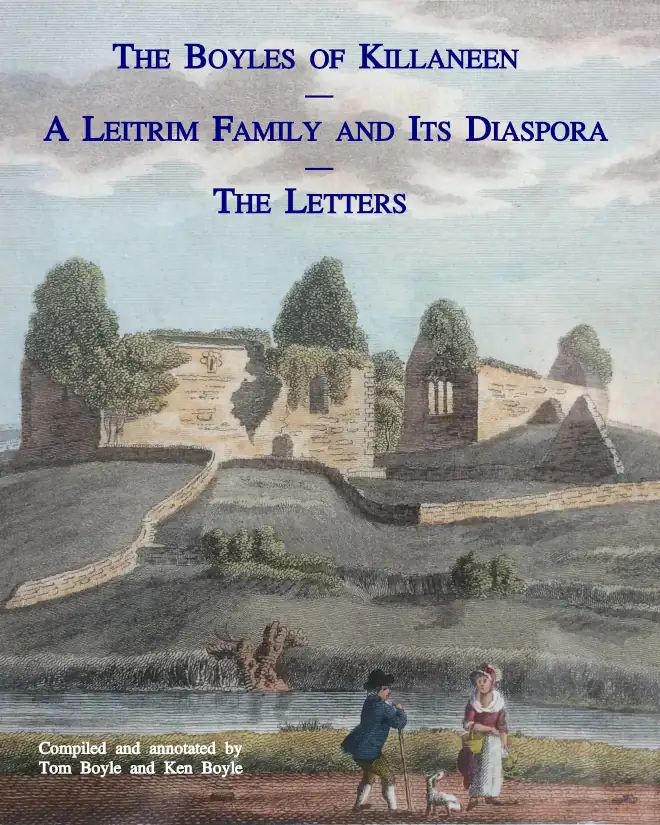
The Lockdown periods from March 2020 onwards provided many people with the opportunity to pursue time consuming indoor projects, if they were fortunate to have any. I was lucky when my cousin Tom Boyle contacted me in early 2021 with a plan to commit about 100 years of family letters into book form to share across the extended family, in Ireland and abroad. The compilation, spanning the years 1893-1994, contains letters, postcards and telegrams that were written by, or to, four generations of our family. There are also a small number of other related documents. Tom lives in Boston, his Grandfather Joe Boyle, my Granduncle, left Leitrim for the U.S. in 1900, aged 18, returning on at least one occasion that we are aware of. The Boyles lived in Killaneen, about 3 kilometres south west of Ballinamore on a farm of about 22 acres, they have also been recorded over the generations as being skilled stone masons and carpenters. We can trace a Boyle family connection to the area back to at least the mid to late 1700’s via the original Boyle headstone erected by one Daniel Boyle to his parents within the walls of the local Fenagh Abbey. Tom and I have collaborated for 10 years on researching our family’s history. He is the ‘computer guy’ who is also gifted at on-line research and he has created a comprehensive digital record of our family history as well as that of his Italian-American Mother’s family, the Zallios. My role is more about providing and explaining the Irish context to much of our findings as well as going about procuring actual items, documents, photos etc. relating to the Boyles.
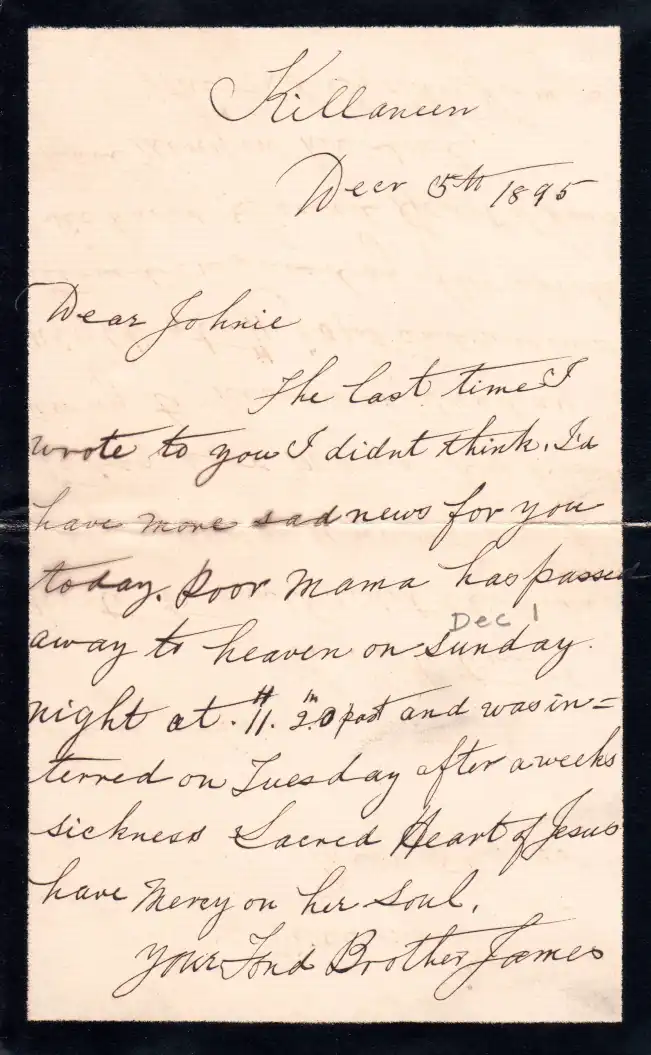
Two generations of the Boyle family emigrated from Killaneen beginning with the departure of my Granduncle, Patrick Boyle, who arrived in the U.S. around 1880, aged 22. Patrick’s emigration set a trend and three of his nine siblings, all brothers, would follow him to America. The departure rate would sadly turn to a flood in the following generation, with four of the family emigrating to the U.S. and two to England. In addition seven of their nine Doherty cousins, the children of Patrick Boyle’s oldest sister Mary and her husband John Doherty from Knockmullin in Fenagh, also emigrated to America. With no practical telephone contact in those years letters became a very important connection between emigrants and home and often contained remittances of money from the U.S., and later legacies, to support parents and younger siblings like those left in Killaneen. The oldest letter we have in our collection dates back to 27th December 1893 and is written by Patrick’s Father Thomas Boyle, my Great Grandfather, to his son Jonny (John) in America and in it he thanks Jonny for a Christmas gift of £4. The letters cover a wide range of topics, often providing interesting news from home and, in return, the progress of family members abroad, against the background of such major events as World War 1, the War of Independence, the Depression and World War 2. Some letters from home contained sad news such as those advising the deaths of my Great Grandparents, Thomas and Bridget Boyle, within two months of each other in 1895. Other letters from abroad often contained joyous references to marriages and births.
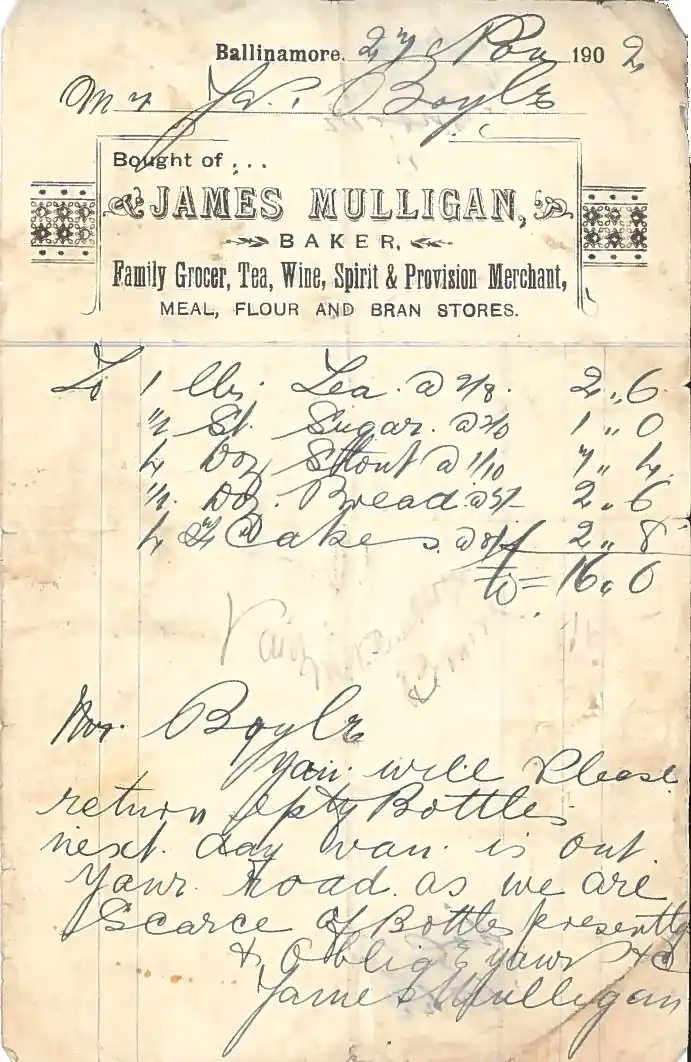
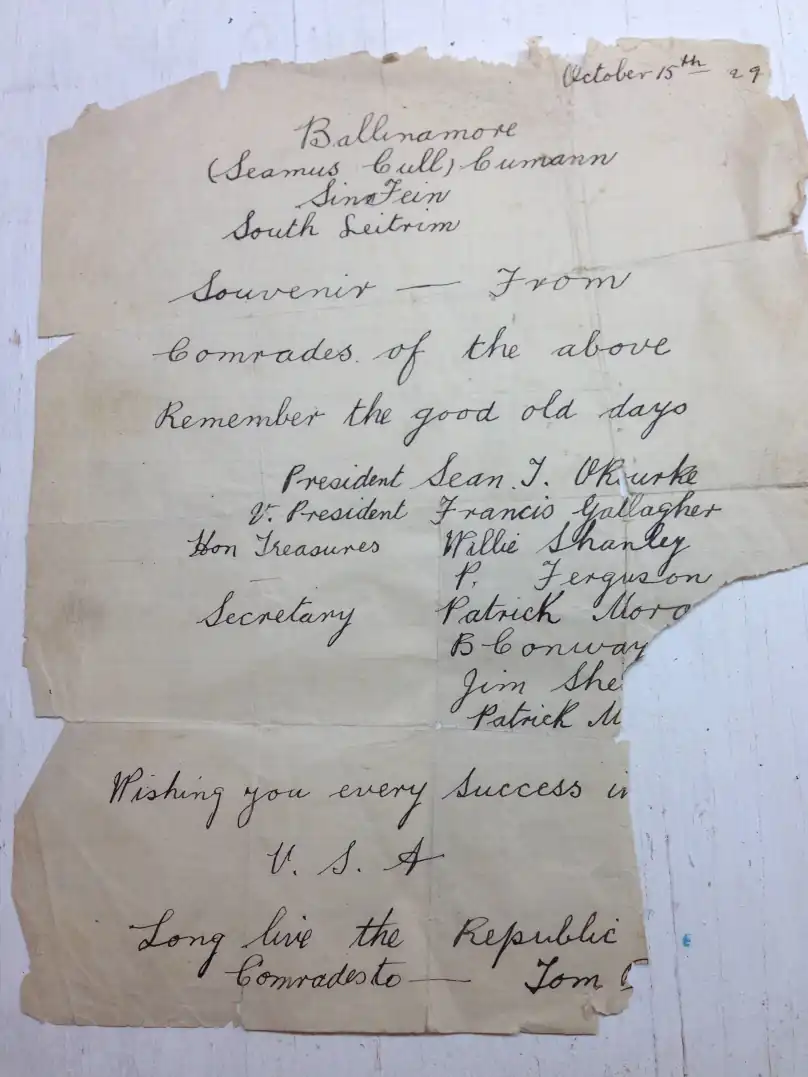
Most families are slow to throw out all old documents and instead retain some, often those items considered to be of importance for age or content reasons. We were particularly fortunate in being able to put together, from different sources, a collection of a hundred years of correspondence spanning four generations, chronicling the emigration patterns and the lives of the family’s members. What can we learn from the collection? First and foremost we can see the effectiveness of letter writing as a communication tool in maintaining family bonds over long periods, and across great distance, in the absence of physical contact. Sad to say those family members that went abroad and didn’t maintain communication by correspondence were gradually lost to the family circle, as were their offspring, if any. As mentioned the letters also provide evidence of the regular remittance of money home to Killaneen and also substantial legacies which a Leitrim historian has found of benefit in their recent research into such remittances. In one letter, Patrick, who was the first to emigrate in 1880, tells his Mother all of 15 years later that he and his two brothers, also in America, ‘will keep up our end that is the financial end’. The inference was that it fell to the siblings remaining in Killaneen to maintain the family home and farm and look after their aging parents while the emigrants would assist financially. It would also appear that the emigrants were generally content with their choice to emigrate and grasped the new opportunities available to them abroad. Any indication of a desire to return home was only referred to on a visit basis. We also see that in Chicago, where the Boyles mostly settled, they were in touch with cousins and neighbours from back home who had also emigrated. That way they were able to maintain contact with many fellow Leitrim emigrants including their Murphy cousins from Gorvagh, O’Rourke cousins from Crimlin near Aughnasheelin, Muldoons from Cloodruman, Fenagh and of course their Doherty cousins from Knockmullin in Fenagh. Family bonds and Leitrim community bonds were of great importance to them, as was the news from home which they regularly asked for in their letters home. On account of the emigrants’ desire for news from home we learn a certain amount of what was happening in the Killaneen area in the late 1800’s and early 1900’s, e.g. deaths and marriages and the movement of people from a farming background, like the Martins and Flynns, from the land into the town of Ballinamore to set up in business.
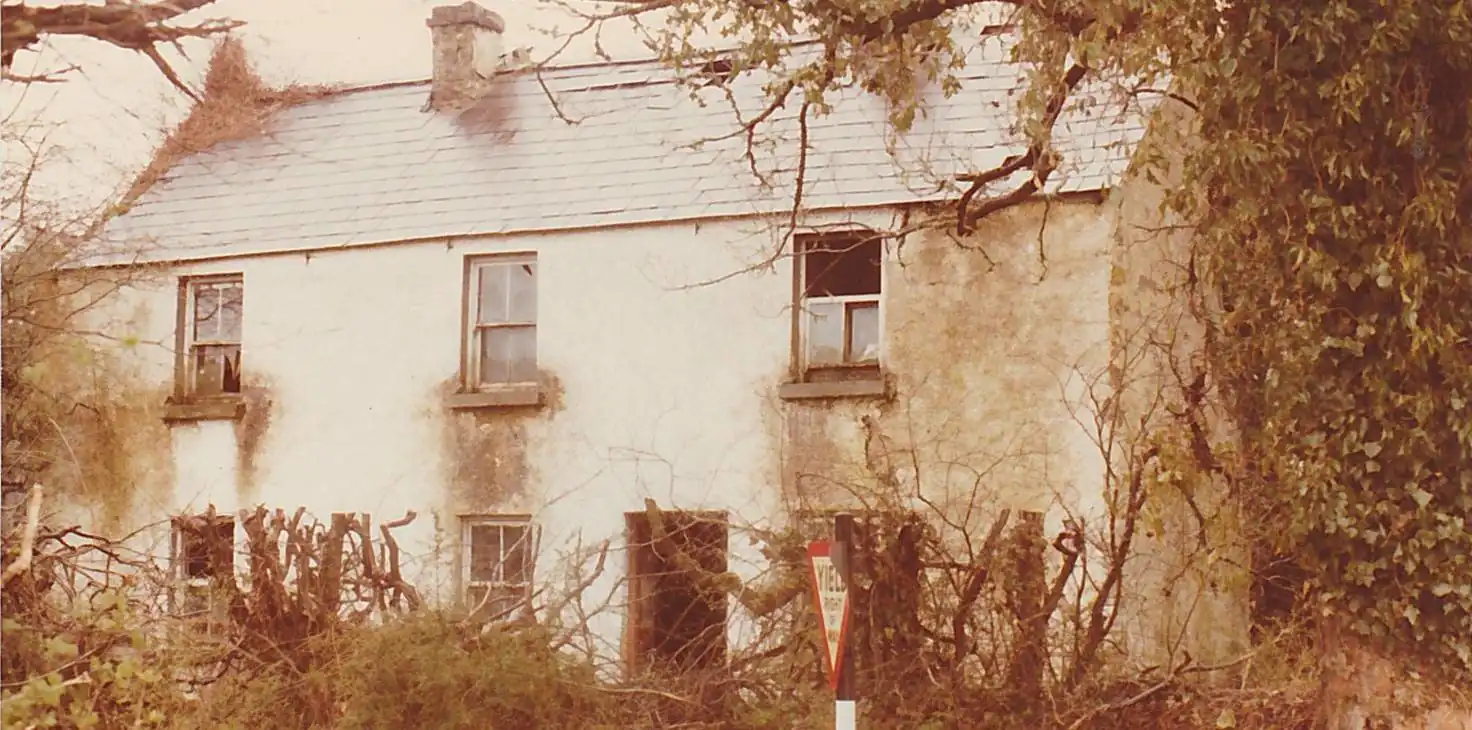
My family’s connection with the house and small farm on Tully Lane in Killaneen effectively ended in 1979 with the death of my bachelor Uncle, John Boyle. My own Father, William Boyle, had left the family home in 1935 to join the Garda. Ties to the home place and the peaceful beauty of Leitrim do not die easily and myself and some of my siblings in Ireland and our Irish American cousins still make regular visits. The story contained in the Boyle Letters book is not unusual as emigration has been the scourge of Leitrim since at least the Famine. What is perhaps unique about the book is the access to such a long period of correspondence and other documents presents an opportunity to explore the Leitrim emigration experience through one family and their cousins. In that sense the book is an addition to the local history archive of Leitrim as well as being of interest to the extended family. As many families in Leitrim live in houses that they have occupied for many generations I have no doubt that there are similar caches of old interesting letters hidden away waiting to be discovered. Local history, and the recording of it, is of huge importance to any community. In this regard the Leitrim Guardian has long been a champion of local history with each edition typically containing a number of very interesting articles on this subject. Additionally the Young Historian Programme which has been running for a number of years for Transition Year students in Leitrim schools is seeking to foster an interest and learning of history among the younger generation. The programme is overseen on a volunteer basis by Fiona Slevin, local historian, and Dr Natalie Fryde, Emeritus Professor of History, in partnership with Leitrim County Library. It encourages Transition Year students to submit projects relating to the history on their own doorstep, thereby helping them to develop skills such as research capabilities, critical analysis and storytelling.
The Boyle Letters book contains over 300 large pages, nearly A4 size, it includes a transcript for each letter and postcard for ease of reading. The book is self-published on a non-profit basis and can be purchased online from Blurb.com for c.€25 plus shipping. It is also available to purchase from the Genealogy Centre in Ballinamore and at Mulveys and The Reading Room in Carrick on Shannon. The book can be accessed through the library system in Leitrim.
Notes
All rights reserved by Ken Boyle. Reproduced on Leitrim Books with permission.