
When Wolfe Tone Wrote a Novel
THE Autobiography of Theobald Wolfe Tone shares with John Mitchel’s Jail Journal the virtue of being not only a great piece of revolutionary literature but also a story of intense and abiding interest. It is one of those rare books which bear the stamp of a rich and compelling personality on every line, a book which even those who are least in sympathy with the principles and outlook of the author can read with interest and enjoyment.
Wolfe Tone was a many-sided man; he loved music and laughter and children; he liked to enjoy himself and was fond of the good things that life had to offer; at one moment he was the fearless, capable, level-headed leader, at another he was playing practical jokes with Emmet at Rathfarnham or with Russell on Ram’s Island. He was not only a great patriot; he was also—in the best sense of the word—a great playboy.
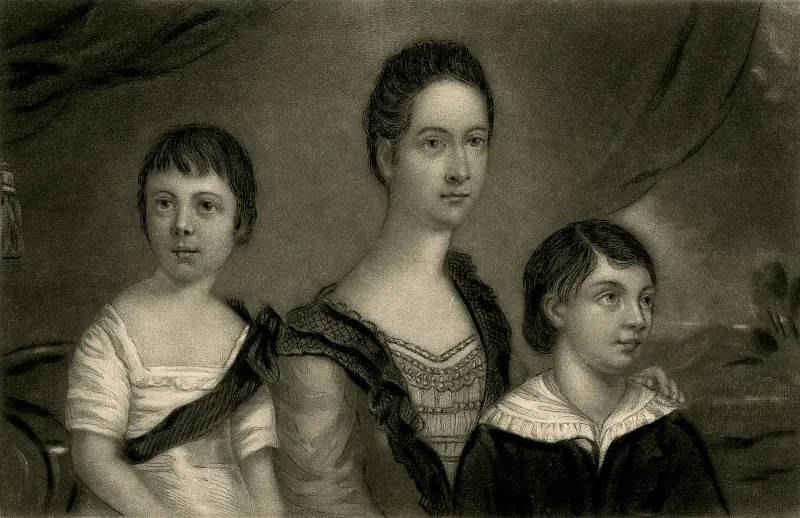
Even at school his talent for leadership and his love of adventure made him a hero amongst the boys. His father, having met with an accident, retired to the country and placed him in the care of William Craig, a clergyman, who kept a school in Stafford Street.
I began to calculate that, at the slow rate chalked out for me by Craig, I could very well do the business of the week in three days, or even two; if necessary, and that consequently the other three were lawful prize. I therefore resolved to appropriate three days in the week, at least, to my amusements, and the others to school. I found no difficulty in convincing half-a-dozen of my school-fellows of the justice of this arrangement of our time and by this means we established a regular system of what is called “mitching.” I must do myself and my school-fellows the justice to say that although abominably idle, we were not vicious; our amusements consisted in walking to the country, swimming in the sea and attending parades and field-days in the Park.
His Law Studies.
At twenty-one he falls in love with a seventeen-year-old girl “more beautiful than an angel,” woos her in whirlwind fashion and marries her after a romantic elopement. He goes to London to study law and enters his name on the books of the Middle Temple. But in that gallant, adventure-loving spirit there was none of the stuff that lawyers are made of; he hated that “illiberal profession”; “after the first month,” he says, “I never opened a law-book, nor was I ever in Westminster Hall three times in my life.” But money had to be earned and so he turned his hand to journalism, writing articles, mostly reviews, for the literary monthlies. In two years he only earned about £50, but even that was welcome to a needy student.
Book Reviewing.
Most of the books that Wolfe Tone reviewed were novels. Fiction just then was being produced in enormous quantities and circulating libraries were springing up like mushrooms. The novel had come into existence less than fifty years previously when Samuel Richardson had written “Pamela,” had grown into shapeliness and strength under Fielding and Smollett, and was now the hobby of every girl straight from a boarding-school who imagined she could wield a pen. Two types of the novel had sprung into public favour at the time when Wolfe Tone became a reviewer; the “novel of terror,” popularised by Mrs. Radcliffe, with its picture of haunted castles and gloomy dungeons, and the “novel of sensibility” which had for its object the portrayal of “the lacerated feelings of the human heart.”
The average “sensibility” novel was sad rubbish, and to a reviewer with Tone’s sense of humour must have presented qualities as comic as the stupid sex novel of to-day. His reviews must have lacerated the susceptibilities of the unhappy authors as much as they had lacerated the hearts of their heroes and heroines; they would make good reading to-day, but as his contributions to the “European Magazine” and other periodicals of the kind were anonymous there is now little hope of identifying them.
With two student friends who shared rooms with him at No. 4 Hare Court, in the Temple, Tone conceived the idea of writing a burlesque novel which would parody the worst faults of the popular fiction of the time.
“In conjunction with two of my friends named Webb and Radcliff I wrote a burlesque novel, which we called ‘Belmont Castle,’ and which was intended to ridicule the execrable trash of the circulating libraries. It was tolerably well done, particularly Radcliff’s part, which was by far the best; yet so it was that we could not find a bookseller who would risk the printing it, though we offered the copyright gratis to several. It was afterwards printed in Dublin and had some success though I believe after all it was most relished by the authors and their immediate connexions.”
Doubt has been expressed as to whether Wolfe Tone’s literary joke was ever given the dignity of print, and even bibliographers have thrown doubt upon its existence. But the matter can now be put beyond all question. The statement in the “Journal” is literally true; the book was published in Dublin. The present writer is fortunate enough to possess a copy, and one other (in the possession of the National Library) has been identified within recent years.
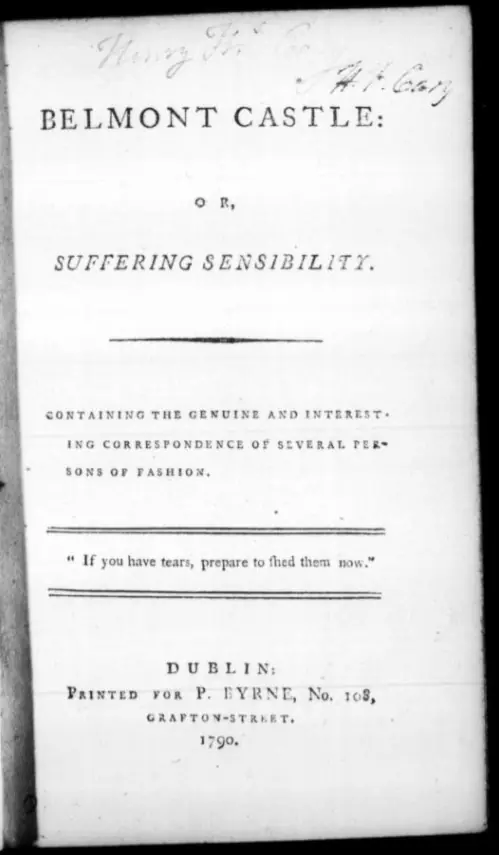
The publisher was P. Byrne, of 108 Grafton Street, and the year of publication was 1790. It was issued in the usual novel format of the period, a small octavo of 224 pages. The book is dedicated, with becoming gravity, to a “Mrs. Carden,” a lady who is declared to possess “a mind glowing with the modest beauties of real sentiment and unaffected sensibility.” In a foreword, the reader is assured that “the following tragic events are not, like the common run of novels, the product of a heated imagination.” Far from it! “All the calamitous circumstances, so unaffectedly and mournfully painted are strictly and uniformly true!”
The story itself need not detain us. It is written in the epistolary form beloved of contemporary novelists, in which the various characters bare their hearts and their tender emotions to one another on scented notepaper. There are the usual posturing heroes and swooning heroines, the high-falutin, artificial diction, the balls, routs, duels, and elopements. It is all done in a spirit of the richest humour.
Hear the gallant “Sir James Dashton,” resplendent in fine lace and powdered wig paying his addresses to the lady of his affections:
“Bright nymph!” he exclaimed, throwing himself on one knee, “I here swear, by the irresistible divinity of love, to devote myself to thy service, to assert thy superiority over all thy sex, and to give to thee the triumph of conquering and holding in adamantine chains the proud, stubborn heart of the hitherto victorious Dashton!”
Or listen to this description of the hero:
“His complexion, though not delicately fair, was as beautiful as the most happy composition of the brightest vermilion and the most brilliant pearl. But his eyes! his eyes darted such looks as penetrated the very soul, at the same time that there shone from them such a god-like benignity as inspired confidence and love.
Passages such as these are of the very essence of parody, and they must have annoyed the circulating library novelists as much as they gave entertainment to their writers. Wolfe Tone, particularly, must have been enjoying himself. He was a whole-hearted hater of fustion and artificiality and his own literary style is so clean-cut and direct that it must have given him great pleasure to sharpen his pen at the expense of the pretentious bores whom he set out to burlesque.
“Belmont Castle” is not, perhaps, of any great importance in the history of literature, but it is a book which Irish collectors will always treasure as a sidelight upon the character of a man who, if he had not been a great revolutionary leader, might have been a great writer.
The Wolfe Tone who took a hand in the writing of it was but a needy student, embarked upon a career for which he had no great love; in those merry evenings at Hare Court there was no thought of interviews with the First Consul at the Luxembourg or of a Christmas Eve in Bantry Bay. In the cloistered peace of the Temple there was no premonition of the guns of revolution, no shadow of a cell in Newgate Gaol.