
Kate Ann Fox
Biography

Kate Ann Fox (1900–1974) was an Irish poet whose published collections captured both the rural traditions of County Leitrim and the daily realities of domestic work in mid-twentieth-century Dublin. Writing under the name K. A. Fox, she published four slim volumes of verse with the Dublin firm James Duffy & Company: Poems by a Working Girl (1944), Further Poems by a Working Girl (1947), Mass Rock and Other Poems (1950), and New Poems (1972).
Throughout her working life, Fox earned her living as a housekeeper in Dublin, writing poetry in the quiet hours between household duties. Her work earned the praise of notable literary figures, including the historian and Senator Helena Concannon, the professor Father George O’Neill, and her employer, the textbook author Elenor Butler. Characterized by simple meter, direct language, and a strong moral outlook, her poetry gave voice to the homesickness of rural migrants, the quiet dignity of manual labor, and the traditional religious faith of ordinary Irish people.
Early Life in North Leitrim
Kate Ann Fox was born Catherine Ann Fox on 22 May 1900 in the townland of Unshinagh (often spelled Unshenagh), near Kinlough in North County Leitrim. She was the second of five children born to Patrick Fox, a farmer, and Mary Clinton.
Growing up in the narrow glens of North Leitrim, Fox was surrounded by a dramatic mountain landscape that left a lasting impression on her imagination. The parish lay between the Dartry Mountains and the Atlantic coast, within sight of the steep valley slopes locally called “alts”—a term derived from the Irish word ailt—and near historic landmarks like Cloonawillin and Glenade Lake.
Fox received her early education at Uragh National School, where she was taught by the principal teacher, Miss A. Rogan, and assistant teacher, Miss Grace McGowan. She later continued her schooling across the county border at the Convent of St. Louis in Bundoran, County Donegal.
The social life of Fox’s childhood revolved around the family home, farm work, and evening gatherings by the hearth. As she later described in verse, these neighborly visits were filled with talk of crops, local gossip, and oral history, ranging from Land League struggles and the Great Famine to folklore such as the legendary dobhar-chú (water hound) of Glenade Lake. This community culture provided the foundation for her later writing.
Domestic Work and Life in Dublin
Like many young rural women of her generation, Fox left her home county in the early 1920s to seek employment. Around 1924, she settled in Dublin, where she took up work in domestic service. Although she lived in the capital for roughly fifty years, she visited Leitrim regularly and remained closely tied to her family and neighbors.
For many years, Fox was employed as a housekeeper by Elenor Butler (known in Irish as Eibhlín de Buitléir) at 49 Oaklands Park in Ballsbridge, Dublin. Butler was a well-known educator and author of widely used secondary school textbooks, including Irish-language geographies. The two women formed a close and lasting bond. Butler recognized Fox’s talent and provided the quiet encouragement that led Fox to seek publication.
Fox composed her poetry alongside her daily household chores. A 1951 profile in Woman’s Life remarked:
“We are apt to picture poets as pale aesthetic creatures, wandering vaguely through the countryside lost in the throes of composition. Miss Fox quickly dispels that illusion. She writes her works against a background of domestic life, as she goes about her duties as housekeeper in Co. Dublin…”
Her domestic role occasionally entered her verse. She described the physical strain of being “at everybody’s calling,” while finding comfort and self-respect in religious reflection. Yet her mind continually drifted back to North Leitrim. One of her best-known quatrains expressed this ongoing tension:
“My work lies in a city fair,
But my thoughts will ever turn
To a little place among the glens,
The place where I was born.”
Fox remained with Elenor Butler until Butler’s death. On 1 May 1953, Butler died at her home on Oaklands Park; Fox was present at the deathbed and officially registered the passing with the local registrar.
Publication and Literary Encouragement
Fox began placing occasional poems in local newspapers during the late 1930s. The Leitrim Observer printed her poem “Heroism” in August 1939 and “Beauty” in September 1940, while the Donegal Democrat published “Thoughts” in August 1941.
Her first book, Poems by a Working Girl, was published in late 1944 by James Duffy & Company, priced at one shilling. The publication was aided by Senator Helena Concannon, an accomplished historian and writer, who provided a warm introductory foreword. Concannon wrote:
“There is heartsease in the simple music of these verses to which an Irish working girl has attuned the rhythm of her daily toil… It brings us back from the fret and weariness of the class-conscious city to the unspoiled beauty of the countryside.”
The collection was well received by the press. The Dublin Leader commended its honest depiction of ordinary life, and copies even reached the Irish diaspora abroad; in May 1945, the Melbourne Advocate published a favorable review noting the appeal of her “hearth-side poems” for Irish emigrants enduring hard work overseas.
Encouraged by this reception, Fox released Further Poems by a Working Girl in 1947. This second collection, bound in a distinctive primrose paper cover, was twice the size of her debut. Reviewing the book in the Dublin Leader, a critic praised its lack of pretension:
“There is right through all the poems the sincerity and directness of speech of a people inured to suffering and purged of all affectation and make-believe. There is no tortuousness of diction, no straining after effect.”
Elenor Butler actively championed Fox’s work. On 1 January 1948, the Cork scholar Professor Daniel Corkery published an essay titled “Poetry and the People” in The Irish Press, arguing that true poetry should remain connected to the everyday culture of working people. Eight days later, on 9 January 1948, Butler sent a letter in Irish to Corkery offering him copies of Fox’s first two volumes:
“It was I who encouraged the girl to have the poems published, for it seemed to me that they sprang from the heart of the common people. The girl is from Co. Leitrim; but she has been working in Dublin since her youth, with her heart all the while in the glens where she spent her youth…”
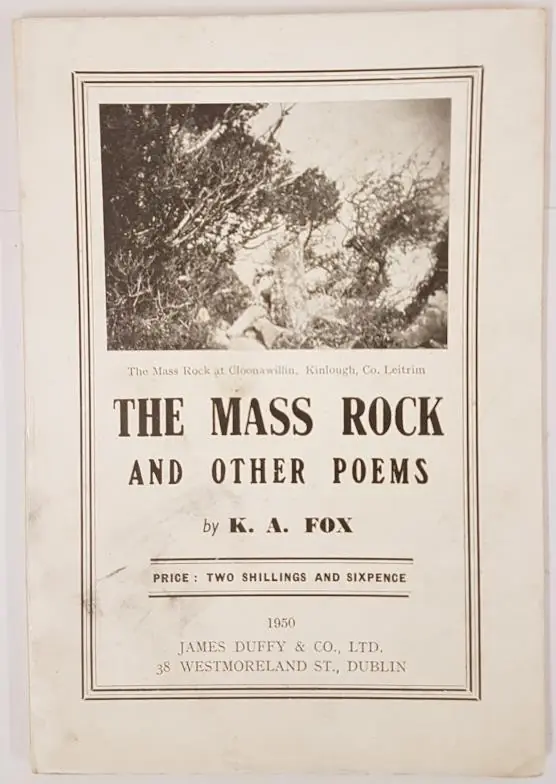
In late 1950, Duffy & Company issued Fox’s third collection, The Mass Rock and Other Poems. Bound in a stiff cover featuring a photograph of the Penal-era Mass Rock at Cloonawillin, near Kinlough, the forty-page book contained thirty-five poems covering religious history, nature, and rural social life.
After a long pause, Fox published a final volume, New Poems, in the summer of 1972. A review in the Irish Examiner highlighted the enduring accessibility of her style:
“K. A. Fox’s poems are easily identifiable and understood by the man in the street. The writing and images are simple. Simplicity is the keynote of this collection’s appeal.”
Themes and Poetic Style
Fox’s poetry avoided complex vocabulary and difficult structures, relying instead on traditional ballad forms, regular rhyme, and clear images. Her subject matter can be grouped into three main categories: landscape and memory, religious faith, and social observation.
Landscape and Leitrim Lore
A major element of Fox’s writing was her detailed recollection of North Leitrim. She frequently referenced local landmarks, such as the Curragh Bawn, the hills above Lisdhu, and the steep “alts” of Benmore. Her lines preserved local idioms and customs, as in her poem “The Old House”:
“I’ve often sat upon the hob
Beside the bright turf fire,
And listened there as tales were told
Of things we all admire…
Of those who gathered there at night
Some sleep in Conwal now;
And some who were but toddlers then
Are now behind the plough.”
Religious Devotion and History
Deep Catholic piety ran through all four of Fox’s books. Her poems often portrayed biblical events in human, relatable terms, such as Saint Joseph in the carpenter shop at Nazareth:
“Just another rub of the plane, little Son,
Just another rub of the plane,
And gather the shavings into a heap,
They’ll help to feed the flame;
For the sun is almost set by now,
It’s time we stopped for the night…”
She also drew on Irish Catholic history. Her title poem, “The Mass Rock,” honored the worshippers of Penal times who gathered secretly at dawn to attend outlawed religious services. Another ballad, “A Famine Scene in Co. Mayo,” described the quiet fortitude of an elderly woman who endured the loss of her family during the Great Hunger.
Social Reality and Character Studies
Fox had an observant eye for character and social hardships. In “Peg McGee,” she described a young woman at a harvest gathering smiling while pouring tea to conceal her heartbreak over a broken courtship. In “Old Martin,” she recorded the good humor of an eighty-year-old countryman struggling with aching joints:
“‘How are you to-day?’ I asked him.
‘I’m first rate,’ was his reply,
‘Even if I’m not so supple
Sure it isn’t but I try.'”
Her verses also dealt with practical problems. In “Encounter,” she addressed the widespread social issue of late marriage and rural poverty through a brief conversation with a young man who could not marry his sweetheart because he refused to bring her into hardship. In the city, she observed the poor and lonely, sketching scenes of hospital wards, the unemployed, and weary travelers.
Critical Reception
Contemporary notices and reviews of Kate Ann Fox’s work in Irish and Catholic periodicals were consistently positive. Rather than measuring her verse against modern literary experiments, reviewers responded to its straightforward sincerity, religious devotion, and close ties to rural life. At a time when cultural commentators like Daniel Corkery questioned whether modern literature was drifting away from the general public, Fox was presented as an example of a writer whose verse remained connected to everyday people.
Several consistent points emerged from the contemporary commentary:
- Simplicity and Directness: Reviewers frequently commended Fox for avoiding difficult or pretentious language. In a 1947 review of Further Poems for the Dublin journal The Leader, the critic “Neall” praised the “sincerity and directness of speech of a people inured to suffering,” noting that there was “no tortuousness of diction, no straining after effect.” Decades later, when Duffy & Co. issued New Poems in 1972, a review in the Irish Examiner made a similar observation, noting that “simplicity is the keynote of this collection’s appeal” and that her lines could be easily “understood by the man in the street.”
- Domestic Life and the Working-Class Writer: Commentators often highlighted Fox’s domestic employment as an asset rather than a limitation. A 1951 profile originating in Woman’s Life (and reprinted in the Donegal Democrat, the Leitrim Observer, and the Sligo Champion) remarked that Fox dispelled the romantic notion of poets as “pale aesthetic creatures wandering vaguely through the countryside.” The article noted with approval that she wrote her verse while carrying out her daily duties as a Dublin housekeeper, producing work that owed nothing to university training.
- Provincial Notice and National Themes: Local newspapers in the northwest followed her publications. When her third volume appeared in March 1951, the Leitrim Observer referred to her as “the Leitrim singer,” drawing attention to the Cloonawillin Mass Rock photograph on the cover. Interest in her work also extended beyond North Connacht. The Limerick Leader reviewed The Mass Rock and Other Poems in August 1951 and again in April 1953, pointing out that while her title poem was written about a site in North Leitrim, its description of secret Penal-era worship held broad meaning for readers in West Limerick, Cork, and Kerry, where similar Mass rocks were being commemorated.
- Support from Elenor Butler: Fox’s employer provided public support on at least two occasions by reviewing her books for the Irish Independent under the initials “E. B.” In December 1947, Butler reviewed Further Poems, praising its blend of country memories, urban vignettes, and religious faith. In April 1953, Butler reviewed The Mass Rock, recommending it as “a bit of Ireland” that was grounded in a sense of the divine and free from “depression or self-pity.”
- Diaspora and Academic Notice: Fox’s first collection also reached Irish readers abroad. In May 1945, The Advocate, a Catholic weekly in Melbourne, Australia, published a detailed review of Poems by a Working Girl. The author, writing under the initials “G. O’N.,” was Father George O’Neill, S.J. (1863–1947), a former Professor of English Language at University College Dublin who was then teaching at Corpus Christi College in Victoria. Writing from the perspective of an English scholar and an Irish priest living abroad, Father O’Neill praised her simple Catholic verse as an alternative to modern literary trends, remarking that the tired domestic worker’s spiritual reflections showed “an art higher than that learnt in schools.”
Final Years and Legacy
Fox lived quietly in Dublin during her retirement. In 1972, the publication of New Poems marked the end of her writing career.
Kate Ann Fox died in Dublin on 6 October 1974 at the age of seventy-four. Following her death, her body was brought home to North Leitrim. Her funeral service was conducted by the Reverend Father Gilsenan, and she was laid to rest in Conwal Cemetery in Glenade—the very graveyard she had written about decades earlier in “The Old House.” An obituary in the Donegal Democrat remembered her as “a gentle-mannered and unassuming girl” whose “love of nature and a special ability to see great beauty in all God’s natural surroundings inspired her to write the poetry for which she became so well-known.”
Fox’s work has received modest local recognition since her death. In 1981, the local historian Séamus Heslin highlighted her contributions in the Leitrim Guardian, noting that her verses offered genuine insight into the dialect, geography, and folklore of North Leitrim. In December 1986, her collections were featured alongside works by prominent regional authors in an exhibition of Leitrim writers at the Ballinamore Branch Library.
Kate Ann Fox remains a distinctive figure in mid-century Irish writing: a working-class woman who maintained a dedicated creative life, translating the quiet memories of her rural youth into verse while going about the daily duties of a city housekeeper.