
Nora J. Murray
Biography
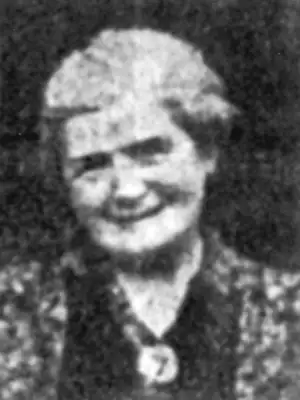
The literary history of post-revolutionary Ireland is often dominated by the towering figures of the Dublin elite—the giants of the Abbey Theatre and the avant-garde modernists who sought to reinvent the Irish voice. Yet, a more intimate and perhaps more representative history of the Irish soul exists in the work of those who lived and taught in the small schoolhouses of the provinces. Among these voices was Nora J. Murray (1888–1955), a poet, teacher, and prose writer whose work bridged the gap between the romantic mysticism of the Celtic Twilight and the starker, more pious reality of the burgeoning Irish Free State.
Born on Main Street in Carrick-on-Shannon, County Leitrim, on 31 October 1888, Hanoria Jane Murray entered a world defined by the “grey ridge” of her home county. Her father, Timothy Murray, was a local draper, and her mother, Jane (née McManus), hailed from the coal-mining district of Arigna. One of eight children, Murray was educated by the Marist Sisters in Carrick-on-Shannon, an institution that evidently nurtured both her intellect and her deep-seated Catholic faith. Her early academic success was recorded in the local newspaper; in 1908, the Leitrim Observer noted her “brilliant success” in the King’s Scholarship Examination, marking her as one of the top candidates in the country and paving the way for her career as a National School teacher.
The Schoolteacher and the “Sedition” Case
Murray’s career as a teacher was inseparable from her identity as a writer and a nationalist. After initial posts in her home region—including stints in Sligo at Ballinfull and Ballywoolin—she moved to County Kildare, taking up a position at Ardclough National School near Straffan. It was here, in 1917, that Murray found herself at the center of a controversy that illustrated the fraught political climate of Ireland in the wake of the 1916 Easter Rising.
In October 1917, Murray and her school manager, Father John Donovan, were notified by the Commissioners of National Education of a complaint alleging “seditious teaching.” The complaint, filed in the name of a British soldier’s wife whose child attended the school, suggested that Murray was introducing inappropriate political themes into her instruction. Father Donovan staunchly defended her, noting that her history lessons focused primarily on the Norman period and that she was a teacher of “high distinction” whose devotion had brought the school to an advanced state of efficiency. Local committees were formed to raise a defence fund, and the Freeman’s Journal reported that the circumstances had generated a strong feeling of sympathy for the manager and teacher in the face of efforts to discredit the school.
The inquiry by the Commissioners was postponed pending legal proceedings which, after considerable publicity, were never initiated. In the aftermath of the controversy, the child of the complainant moved to a Protestant school, while Murray remained at the school with the support of the local community. This period of public scrutiny coincided with the height of her early literary output; it was during this time that she published her primary collection of verse, A Wind Upon the Heath (1918). The volume was well-received by the metropolitan and provincial press, marking her as the first lady teacher of a National School to achieve a reputation as a poet in the modern Celtic Renaissance.
Literary Work
Poetry: The Rhythms of the Soil
Nora Murray’s poetry regularly appeared in Irish newspapers, particularly the Irish Independent. Between 1912 and 1928, she entered at least 44 of the paper’s weekly poetry contests and won the half-guinea prize 14 times. In addition to these, she earned top honors in the Independent’s grand Christmas number for her poem “An Irish Christmas” in 1919. Her award was a handsomely framed original drawing by the artist Charles Alfred Mills, A.R.H.A., illustrating “The Irish Emigrant’s Lament.”
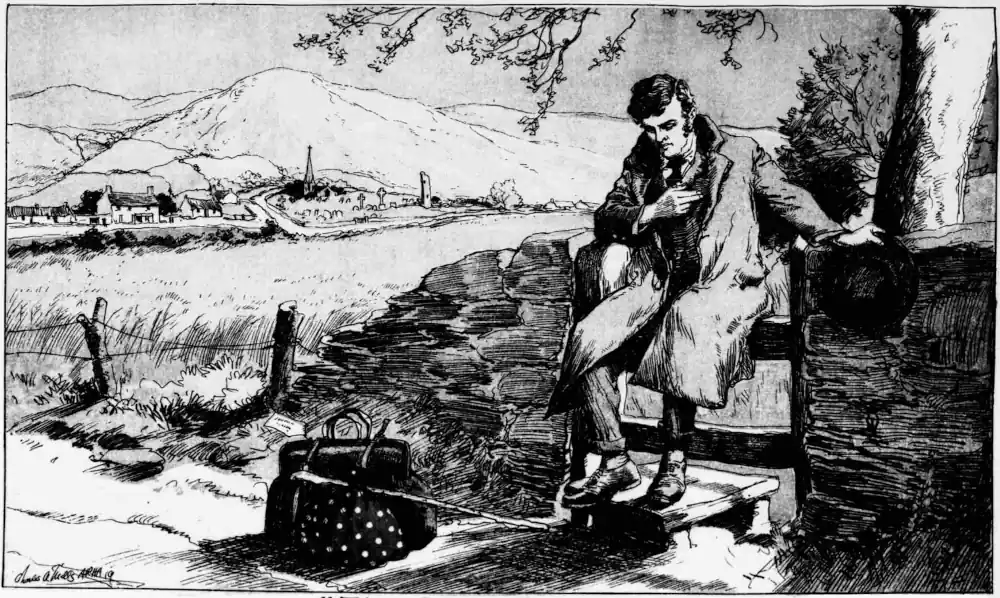
Murray’s work is a mix of quiet nature scenes and deep religious faith. In her 1918 collection, A Wind Upon the Heath, her voice was described by critics of the time as one of “appealing simplicity and freshness.” Rather than trying to reinvent the wheel with experimental styles, she stuck to what she did best: the musical, easy-to-read rhythms of traditional Irish ballads and classic lyrics.
Her favorite themes rarely wavered. She wrote about the rugged beauty of the west, from the mists of “Glencar” to the “noble head” of “Knocknarea”. She also had a soft spot for the innocence of childhood—evident in “The Dancing Child” and “Connor of the Curls”—and a recurring, gentle sadness for “the dead ones” and the relentless march of time.
While many of her poems feel timeless, Murray often anchored her spiritual life in the politics of her day. She frequently used her poetry to mourn the figures of the Irish revolution, viewing their struggle through a Catholic lens. She wrote “Banna Strand” to remember Roger Casement’s landing in Kerry, “Consummatum Est” as a tribute to Terence MacSwiney, and “The Dead Poets” to honor the leaders of the 1916 Rising.
Beyond the political, Murray had a real knack for capturing the small details of country life. In “The Little Wooden Stool,” she celebrates the “snug thatched cabin,” and in “Ballad of Leitrim Tinkers,” she captures the “yelling parade” of travelers with a bit of grit and humor. In her later works like “The Day of Consecration” and “Little Town,” she leaned into this nostalgia, paying tribute to a rural way of life she could see slowly disappearing.
Short Stories: Realism, Satire, and the Troubled Times
While her poetry was often ethereal and romantic, Murray’s short stories showed her ability to write everything from sharp satire to gritty social realism. These stories are essential for understanding her contribution to the Irish short story; they are rooted in local dialect and show a deep empathy for those on the edges of society—the destitute travelers, the “simpletons,” and the “old whitebeards.”
In her satirical piece “Disillusionment of Twin Souls” (1920), Murray takes a witty swipe at the romanticized view of “the simple life.” She tells the story of two “Bachelor Bohemians”—a poet and an artist—who leave the comfort of Dublin suburbia to find “true environment” in a run-down country cottage they call Innisfree. Their dream of rural bliss quickly turns into a nightmare as they struggle with back-breaking labor like drawing water from the bottom of a hill and dealing with unwanted roommates such as wasps, stray cats, and a “colony of mice.” The final straw comes when a storm causes the roof to leak and a “geyser of muddy water” erupts from a hole in the kitchen floor, prompting their retreat to the city to trade rural fantasies for the safety of knitting and painting Christmas cards.
Murray explored themes of family tension and class in “Princess of the Golden Hair” (1921). The story follows Mary Lane, a spirited girl from an orphanage nicknamed for her “carrotty” hair, who is hired as a servant and eventually elopes with Jim, the son of a wealthy, mean-spirited widow. The bitter rivalry between the two women ends in shared tragedy when Jim dies in a cart accident and Mary shortly follows after a bout of pneumonia.
Conversely, stories like “Between the Tides” (1921) and “A Blossom of Spring” (1922) explore the harshness of poverty and the specter of death. “Between the Tides” is a tragic tale set in a fishing village, where the Spanish Flu epidemic and the grinding toil of the kelp gatherers provide a backdrop for a story of unrequited love and familial collapse. “A Blossom of Spring” uses the setting of a Dublin hospital dispensary to recount the trauma of the 1916 Rising through the eyes of a woman whose doctor was shot dead at her door as he was coming to attend her.
In “Sabina” (1926), Murray weaves a theme of temperance into a tragic romance. Years after a drunken row drove childhood sweetheart Big Joe Mulvey to join the militia, he returns to Sabina’s life, wounded in a street brawl. Sabina initially rejects his proposal, refusing to “face life” with a man who chooses a bottle over her. Though Joe vows to reform, he relapses during their wedding festivities and dies from a brain injury, leaving Sabina a widow still dressed in her bridal array.
Later stories, such as “The Funeral Man” (1933) and “Unexpected Gifts” (1937), blend character study with the politics of the “Troubled Times.” In “The Funeral Man,” she introduces Owney, a vagrant obsessed with wakes, whose arrest by the “Tans” turns him into an accidental hero in the eyes of his village. Finally, “Unexpected Gifts” offers a lighter take on the period, involving two soldiers who try to steal a farmer’s turkey but end up captured by the local Flying Column. They eventually bribe a poor local man, Johnny Moran, to help them pretend they were “heroes” rather than simple turkey thieves.
The Essays: Landscape as History
In the 1930s, Nora Murray became a regular voice in The Capuchin Annual. Her essays during this time shifted away from fiction toward a mix of cultural history and landscape writing.
In her 1932 essay “Mary Redmond,” Murray tells the story of the only Irish woman of her time to become a professional sculptor. She follows Redmond from her childhood playing with yellow clay in the Kildare limestone quarries to sculpting the famous statue of Father Mathew in Dublin’s O’Connell Street. Murray uses Redmond’s story to lament the “stern depopulation” of the Irish countryside and the decline of rural industries like the limestone quarries of Ardclough.
Her travelogues of Sligo and Leitrim are considered some of her best prose. In “Leitrim of the Lakes” (1935), she describes her home county as the “Cinderella of Connacht”—a place ignored by tourists but full of quiet beauty. She describes the landscape as “grey” and restful, mirroring the resilient spirit of the people who survived famine and war. These pieces aren’t just about scenery; Murray fills them with “tender and bitter memories,” from the “merciless harrying” of priests during the Penal Laws to harrowing accounts of the Famine in 1847, where whole families were found dead in their cabins.
In “A Ridge of the West” (1934), she takes the reader on a tour of the mountains and glens around Lough Gill. She mixes local folklore, like the enchanted cats of Killavoggy, with hard historical facts about the Cromwellian plantations that saw “every valuable site” taken from the native Irish. Throughout these essays, Murray captures the green peace of rural Ireland while making sure the struggles and sacrifices of its past are never forgotten.
Dublin Life and Legacy
In August 1919, Nora Murray married Alfred Denis White at St. Kevin’s Church in Dublin. White was a significant figure in the Irish Republican movement, having served on the H.Q. Staff of the Fianna Éireann in 1910 and later as an Adjutant in the 26th Battalion during the Emergency (declared state of emergency during the Second World War). The couple settled in Dublin, living first on Peter Place, then on Crumlin Road, and finally at 15 Serpentine Avenue in Ballsbridge.
Though she had left the schoolroom, Murray remained a central figure in Dublin’s religious and literary circles. Their home became a meeting place for prominent writers and thinkers of the era, including the novelist Francis McManus and the Capuchin editor Father Senan Moynihan. Murray was a devout member of the Third Order of St. Francis (T.O.S.F.), a fact that reflected her lifelong commitment to the intersection of Franciscan spirituality and Irish cultural life.
Nora Murray White died on 15 June 1955, at the Bon Secours Hospital in Glasnevin. Her death notice in the Irish Independent identified her as a beloved wife and a dedicated member of her religious order. She was buried in Glasnevin Cemetery, far from the “silver waters lapping” under the bridge in Carrick town, but her work remained a testament to the landscape she never truly left.
Murray’s Body of Work
Looking at Nora J. Murray’s body of work as a whole, one sees a writer who functioned as a cultural conservator. She was not a modernist seeking to dismantle the past; she was a traditionalist seeking to preserve it. Her work represents a specific “middle-brow” Irish literature that was immensely popular in the mid-20th century—writing that was accessible, moral, and fiercely local.
Her primary contribution was her ability to articulate the “hidden Ireland” of the peasant home and the village street. While the literary giants of her day were often concerned with the “State of the Nation,” Murray was concerned with the “State of the Parish.” Her stories and essays provide a granular look at the effects of the Irish War of Independence and the Civil War on ordinary families, often using humor and irony to soften the blow of tragedy.
Critically, Murray’s work is characterized by a “blessed sadness”—a term she used herself in the poem “A Wind Upon the Heath.” There is a recurring sense that the modern world is a place of noise and “geometrical irritations,” while the true heart of Ireland resides in the olden stories and the hallowed walls of the country chapel. Her writing resonated with the deep-seated yearnings of the Irish diaspora, a sentiment she reinforced by quoting an American exile’s letter to the editor of The Capuchin Annual that movingly declared County Leitrim to be the place “where my heart is always.”
In the end, Nora Murray was more than just a “lady teacher” who wrote poetry. She was a chronicler of a vanishing way of life. Whether she was observing the swans drifting under the arches of the bridge in her native Carrick or the “ghostly strings” of a fiddle heard near a Sligo mountain, she remained a writer of the “grey ridge.” She was an author who understood that the history of Ireland was written not just in blood and steel, but in the “whisper of leaves” and the “humming of bees” across the heather bogs of the West.
 Amazon.com (US)
 Amazon.ie (Ireland)
 Amazon.co.uk (UK)
 Amazon.ca (Canada)
 Amazon.com.au (Australia)
 Amazon.de (Germany)
 Amazon.fr (France)
 Amazon.es (Spain)
 Amazon.it (Italy)
 Amazon.nl (Netherlands)
 Amazon.pl (Poland)
 Amazon.se (Sweden)
 Amazon.com.be (Belgium)
 Amazon.co.jp (Japan)