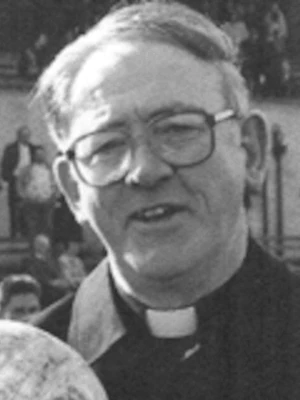
Fr. Daniel Gallogly
Biography
Early Life and Education
Daniel Gallogly was born in Drumraine Glebe, County Leitrim, Ireland, on 2 October 1935 to John James (Jack) Gallogly and Mary Ellen Gallagher. He was the youngest of four children, alongside his siblings Christy, Joe, and May. Growing up in this rural town, he developed a strong sense of community and faith from a young age. He received his early education at Ballinamore Boys N.S., where he was taught by Sean O’Heslin. He then attended St. Patrick’s College, Cavan, from 1949 to 1954, and pursued a calling to the priesthood for the Diocese of Kilmore at Maynooth College (1954–1961). Father Gallogly was ordained a Catholic priest on 18 June 1961. His deep interest in Irish history and culture would soon become evident in both his pastoral work and extracurricular passions.
Priesthood and Educational Career
Following his ordination, Fr. Gallogly served as a curate in Bunnoe, Drung, from 1962 to 1964. Soon after, he joined the staff of St. Patrick’s College in Cavan, a diocesan boys’ secondary school and former minor seminary. He began teaching at St. Patrick’s College in 1964, where he was an Irish language and history teacher. In the classroom he was known for his dedication and engaging style – one former pupil later recalled that Fr. Dan, “our teacher of Irish and history, who later became president of the college,” was “no less influential” in shaping students’ lives than the school’s other revered mentors. His enthusiasm for Irish heritage and the Gaelic language inspired many of his students. Fr. Gallogly also became involved in coaching and mentoring the school’s football (Gaelic football) team. In 1972, St. Patrick’s College won the All-Ireland Colleges Football Championship (Hogan Cup), and Fr. Dan played a “pivotal role” in that victory as a trainer and motivator.
His leadership abilities and commitment to the school led to his appointment as President (head administrator) of St. Patrick’s College in 1981. As President, Fr. Gallogly guided the college’s educational mission and continued to support sporting and cultural activities. Under his tenure, the college maintained high academic standards, a strong reputation in Gaelic games, and underwent physical expansions. He remained in that role until 1991, influencing a generation of young men both spiritually and academically. In 1991, he was appointed Parish Priest of Mullagh, County Cavan. During his time in Mullagh, he was instrumental in the establishment of the St. Killian’s Heritage Centre to commemorate the parish’s patron saint and promote cultural links with Würzburg, Germany.
Passion for Gaelic Games and GAA Leadership
Beyond his school duties, Fr. Dan Gallogly had a lifelong passion for Gaelic games, especially Gaelic football. He believed that sport was an important part of community life and youth development. In addition to coaching school teams, he became deeply involved with the County Cavan Gaelic Athletic Association (GAA). Fr. Gallogly served on various committees and championed the values of sportsmanship and local pride. His reputation as an administrator grew, and he rose through the ranks of GAA governance.
By the late 1980s, Fr. Gallogly’s peers in the GAA recognized his contributions by electing him to a prominent provincial role. He served as Chairman of the Ulster Council – the governing body for GAA affairs in Ulster – from 1989 to 1992. This made him one of the few clergymen to hold such a high office in the GAA. During his tenure as Ulster Council chairman, he worked to promote Gaelic games across the province. He was noted for his administrative skills and his ability to bring people together. Colleagues admired how he balanced his priestly duties with his love for sport, often saying Mass in the morning and attending a match or meeting in the afternoon with equal dedication. He later contested the chairmanship of the Cavan County Board in December 1992 and served on several Central Council committees.
Even while serving at the provincial level, Fr. Gallogly stayed connected to his roots. He was especially proud of Cavan’s rich football heritage – the county had won multiple All-Ireland senior titles in the past – and he strove to preserve and share that history. His involvement in the GAA was not just as an official; he was also a storyteller of the games, intent on keeping the memory of past players and glories alive for future generations. This dual identity as priest and “Gael” (dedicated GAA member) made him a beloved figure in Cavan and beyond.
Historian and Author
Alongside his educational and sporting work, Fr. Gallogly built a remarkable career as a local historian and author. He had a passion for documenting the history of his community, church, and Gaelic games, serving as both a contributor to and editor of Breifne, the journal of the Breifne Historical Society. In the 1970s, while still a young priest, he undertook a major historical project for the centenary of the very school where he taught. In 1974, Fr. Gallogly co-authored St. Patrick’s College and the Earlier Kilmore Academy: A Centenary History with fellow priest-historian Fr. Terence P. Cunningham. This comprehensive history marked the 100-year anniversary of St. Patrick’s College, Cavan. The book traced the school’s origins as the “Kilmore Academy” in the 1800s, its founding in 1874 as St. Patrick’s College, and its development over a century. Filled with archival research, anecdotes of school life, and photographs, the centenary history became an important record of the college’s role in education and the Catholic community in Cavan. Fr. Gallogly’s contribution to the project ensured that the legacy of the school – from its spiritual formation to its sporting triumphs – was preserved in print.
A few years later, Fr. Dan Gallogly turned his historical pen to his other great love: Cavan football. In 1979 he published Cavan’s Football Story (sometimes referred to as “The History of Cavan GAA”) under the auspices of the Cavan GAA County Board. This work was a sweeping narrative of Gaelic football in County Cavan, from the founding of the GAA in the 1880s through to the modern era. Fr. Gallogly recounted the establishment of clubs in each parish, the early county champions, and Cavan’s famous All-Ireland victories. He brought to life the great matches and personalities of Cavan GAA. For example, in Cavan’s Football Story he vividly described the legendary player Jim Smith (who captained Cavan to the All-Ireland title in 1933) as “undoubtedly the greatest footballer of the decade (twenties) – an all-round athlete equally proficient at football, hurling and handball. He combined great physique and determination with elegant fielding and long kicking. He was the hero of Cavan in the twenties and thirties and did an immense amount to fashion Cavan football after his own style.” Such passages illustrate Fr. Gallogly’s engaging writing style and deep admiration for the athletes he chronicled. The book remains a treasured reference for Cavan GAA fans, preserving the county’s sporting lore through a narrative that is both informative and affectionate.
Fr. Gallogly continued writing local history well into the 1980s and 1990s. In 1984, he authored Ballinamore Sean O’Heslins 1889–1984, a history of the GAA club in his hometown of Ballinamore. That book coincided with the club’s centenary and documents the club’s founding and its role in the community over a century. In 1991, he published Sliabh an Iarainn Slopes: History of the Town and Parish of Ballinamore, Co. Leitrim, a chronicle of Ballinamore’s parish history, folklore, and families. This work showcased his meticulous research beyond the realm of sports, covering local events and societal changes in Leitrim from bygone eras. Fr. Gallogly’s historical writings weren’t limited to Cavan and Leitrim – he also contributed to commemorative booklets for church events, such as the dedication of St. Mogue’s Church in Templeport (1979) and the Church of Mary Immaculate in Virginia, Cavan (1989). These works, though smaller in scale, further demonstrated his commitment to preserving the stories of parish life and faith in the region.
In the late 1990s, even as he aged, Fr. Dan undertook one of his most ambitious projects: a diocesan history. He devoted his energies to researching the Catholic heritage of the Kilmore Diocese (his home diocese). The result was The Diocese of Kilmore, 1800–1950, published in 1999 by Cumann Seanchais Bhreifne (the Breifne Historical Society). This scholarly book examined 150 years of religious and social history across Cavan and surrounding areas, detailing the lives of bishops and clergy, the evolution of parishes, and the Church’s role through famine, political upheavals, and independence. It was a capstone to Fr. Gallogly’s career as a historian, encapsulating the breadth of knowledge he had accumulated over decades of study.
Political and Social Views
Fr. Gallogly held firm Republican convictions and possessed a deep-rooted loyalty to his native region. He maintained a close friendship with John Joe McGirl, a prominent political figure in Ballinamore. During the unrest in Northern Ireland, Fr. Gallogly’s pastoral care extended across the border, as he provided practical support and assistance to individuals seeking refuge from the conflict. He was equally steadfast in his defence of County Leitrim’s social and economic viability. Appearing in Colin Thomas’s 1981 RTE documentary ‘None But Devils’ to provide a guided tour of the area, Fr. Gallogly highlighted Ballinamore’s community resilience following the closure of the narrow-gauge railway in the 1950s. He used his appearance to deliver a serious warning about the critical necessity of local employment to prevent rural depopulation and sustain the county’s youth.
Later Years and Legacy
As the 1990s progressed, Fr. Gallogly gradually stepped back from educational administration and high-level GAA officialdom, focusing more on pastoral duties and writing. He remained a beloved figure in County Cavan and County Leitrim, often invited to speak at club dinners, school commemorations, and historical society events. Locals respected him not only as a clergyman but also as a chronicler of their collective memory. He bridged the worlds of church, community, and sport in a unique way.
On 16 June 1999, Fr. Daniel Gallogly passed away at the Mater Hospital in Dublin after a short illness. His death, at the age of 63, was met with widespread sadness in Cavan, Leitrim, and the wider GAA community. Tributes poured in from former students, fellow priests, and GAA colleagues. Many noted how much he had accomplished in intertwining the cultural and spiritual life of the region. As a school president and teacher, he had guided and inspired youth; as a GAA official and coach, he had uplifted communities through sport; and as an author, he had preserved precious history for future generations.
Fr. Dan Gallogly’s funeral was held at St. Killian’s Church in Mullagh and was attended by large crowds, including clergy, local leaders, and GAA figures in their county colors. He was laid to rest in Fenagh Abbey Cemetery, County Leitrim. His published works continue to be referenced in Cavan and Leitrim – the St. Patrick’s College history is still cited by those reflecting on the school’s past, and Cavan’s Football Story sits on the shelves of many GAA enthusiasts.
Today, Fr. Daniel Gallogly’s legacy endures in the institutions and communities he served. The current generation of students at St. Patrick’s College, Cavan walk past photographs of past rectors and see Fr. Gallogly’s name listed among them, a reminder of the college’s formative years. Gaelic games in Cavan continue to thrive on the foundation of pride in history that he helped build. And in Ballinamore, the stories he preserved in print ensure that the town’s heritage – both sacred and secular – will not be forgotten. Fr. Gallogly’s life story flows as a narrative of service: to God, to education, to sport, and to history. In weaving these threads together, he left an indelible mark on County Cavan and its people, one that will be cherished for many years to come.
Works
Books
- St. Patrick's College and the Earlier Kilmore Academy: A Centenary History (1974)
- Cavan's Football Story (1979)
- Ballinamore Sean O'Heslins, 1889-1984 (1984)
- Sliabh an Iarainn Slopes: History of the Town and Parish of Ballinamore, Co. Leitrim (1991)
- The Diocese of Kilmore, 1800-1950 (1999)
Other Works
- Brian of the Ramparts O’Rourke [article] (1962)
- Review of Seán Ó Donnabháin & Eoghan Ó Comhraí [article] (1962)
- Brian Oge O’Rourke and the Nine Years War [article] (1963)
- Inscriptions in Magherintemple cemetery [article] (1963)
- Review of Dinnseanchas [article] (1964)
- 1641 Rebellion in Leitrim [article] (1965)
- Sir Frederick Hamilton [article] (1966)
- Leitrim 1600-41 [article] (1971)
- Land trouble in Templeport 1855 [article] (1979)
- Templeport: Souvenir of the Solemn Dedication of St. Mogue's Church (1979)
- Bilberry Sunday in Leitrim [essay] (1980)
- Leitrim in the Parnellite split [article] (1981)
- An eel weir, marriage agreements from Registry of Deeds [article] (1981)
- Swanlinbar and its ironworks from the Registry of Deeds [article] (1982)
- Hurling in Leitrim with Bog Oak [essay] (1984)
- The Farnham Arms Hotel from the Registry of Deeds [article] (1984)
- The Stalwart Young Men of the 90's [essay] (1984)
- Cavan town and townsmen from the Registry of Deeds [article] (1985)
- Dr Terence P. Cunningham [Obituary] [article] (1986)
- Brian Ó Mórdha 1918-86 [Obituary] [article] (1986)
- Hearth Roll money for the barony of Castlerahan 1664 [article] (1987)
- Index to Breifne 1959-86 [article] (1987)
- Breifne and its chieftains 940-1300 [article] (1988)
- Church of Mary Immaculate Virginia: Souvenir of the Solemn Dedication (1989)
- Breifne and its chieftains 1300-1560 [article] (1990)
- Kilmore Churches [article] (1994)
- Priests and people of Kilmore [article] (1995)
- Patrick Finnegan & the birth of the Irish Free State 1900-23 [article] (1996)
- Carrigallen in the Early Times [essay] (1996)
References
- Club Admin. (2005, February 28). The Great Jim Smith from Killinkere (published Hoganstand in 2005). Killinkere CLG. https://killinkereclg.com/articles/35177
- Death of Fr. Dan Gallogly. (1999, June 23). The Leitrim Observer, pp. 1, 18.
- Death of Mullagh PP deeply mourned. (1999, June 17). The Anglo-Celt, pp. 1, 3.
- GAA: Death of Fr Gallogly. The Free Library. (2014). https://www.thefreelibrary.com/GAA%3a+DEATH+OF+FR+GALLOGLY.-a060448302
- The late Fr. Dan Gallogly. (1999, June 17). The Northern Standard, p. 1.
- Murphy, J. (1999, June 24). Letters to the Editor: The late Father Dan Gallogly. The Anglo-Celt, p. 5.
- Our History. St Patrick’s College, Cavan. (n.d.). https://stpatscavan.ie/our-history/
- O’Donoghue, T., & Harford, J. (2016). Secondary School Education in Diocesan Colleges in Ireland, 1922–1962. In: Secondary School Education in Ireland. Palgrave Macmillan, London. https://link.springer.com/chapter/10.1007/978-1-137-56080-3_3
- Saint Patrick’s College, Cavan. (1991). The Leitrim Guardian, 104. https://leitrimdoc.ie/leitrim-guardian-journal-1969-1999/
- Thomas, C. (1982). None but Devils: How They Saw It. The Leitrim Guardian, 19–21. https://leitrimdoc.ie/leitrim-guardian-journal-1969-1999/