
Honouring our Dead
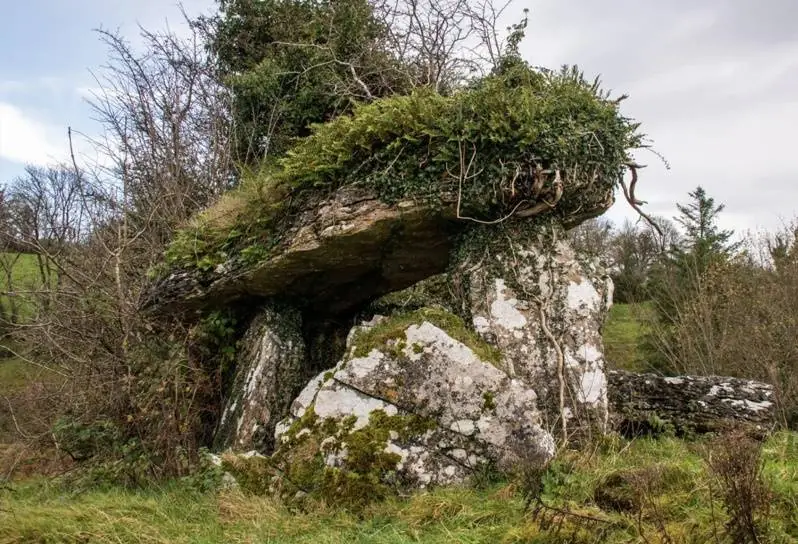
2 commentsMemorials to the dead, going back to prehistoric times, can be found in many parts of Ireland, including South Leitrim. The full significance of the dolmen type structures in the area is dimmed by the passage of time, more recent monuments have their causes etched in stone and local memory. The proximity to each other of three of the latter memorials can cause us to reflect on the justification, if any, for the use of violence to promote political change.
Selton Hill Monument
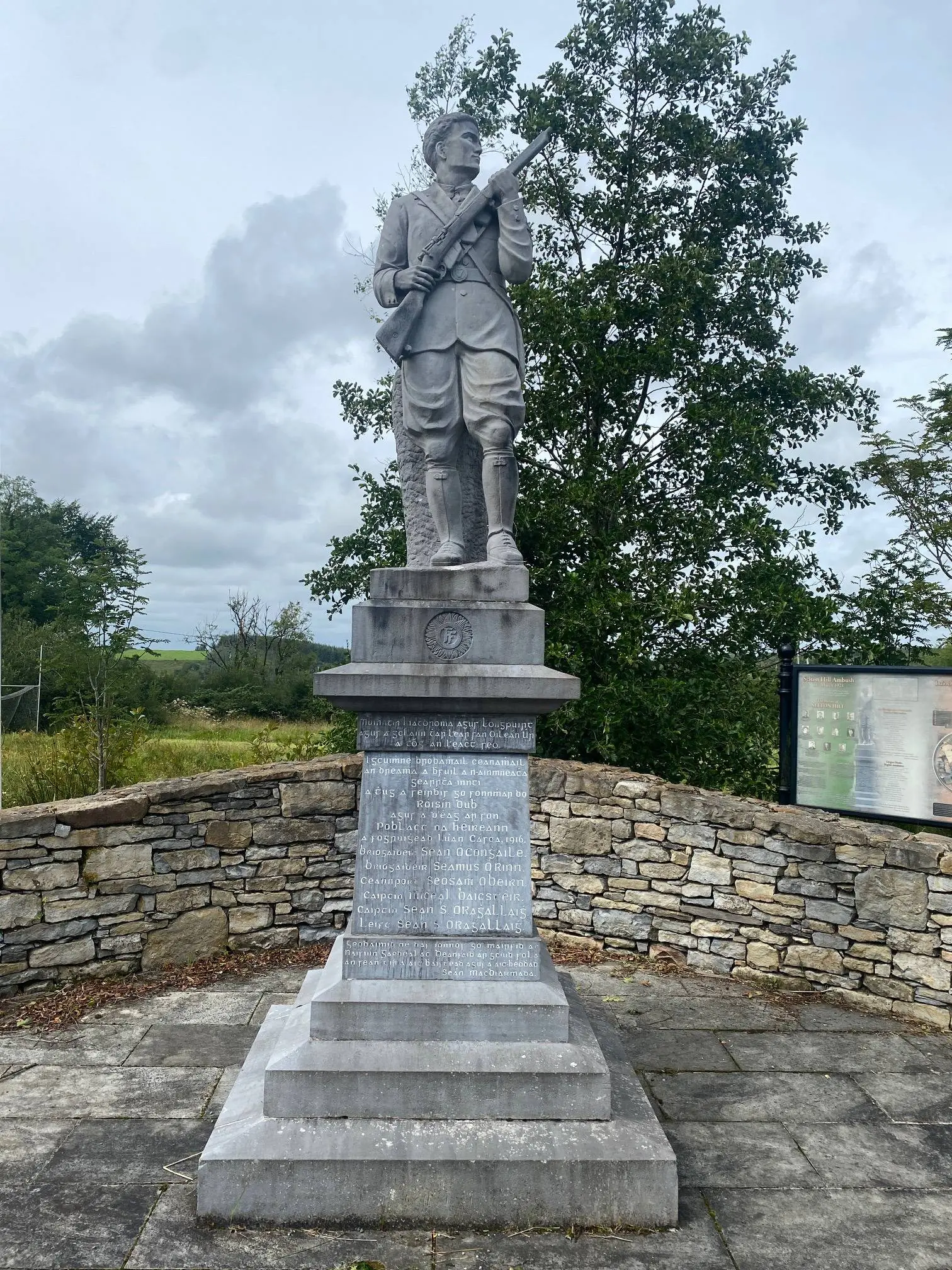
At Selton Hill, fives miles from Ballinamore, there is a striking War of Independence memorial commemorating the deaths of six Irish Republican Army (IRA) volunteers that occurred in March 1921. A Flying Column had stopped at a local house which was in an exposed position and inexplicably they failed to arrange for scouts to guard the main approaches. When word of their presence got back to the Royal Irish Constabulary (RIC), they called out a heavily armed force of British soldiers. The IRA unit was completely surprised by their unexpected arrival and in attempting to retreat, they were quickly overcome by the larger better positioned attacking force. Five of the volunteers were killed, a sixth died later from his wounds, four managed to evade their attackers and another was captured. It was the biggest setback for the Republican movement in Leitrim during the conflict.
After the overwhelming success of Sinn Fein in the 1918 general election and the establishment of the separatist Dail Eireann, the autonomous Irish Volunteers pledged their allegiance to the Dail and became known as the IRA. Thereafter they operated under the democratic and moral mandate of the Dail. The War of Independence came to an end four months after the Selton Hill disaster when a ceasefire between the IRA and British forces came into effect. During the conflict, some IRA tactics, such as the killing of informers and shooting unsuspecting RIC members at close quarters, had come in for criticism, even from within Sinn Fein itself. The IRA were responsible for the deaths of c.200 civilians accused of spying, many of their bodies were secretly buried, or as now described, disappeared.
Following a narrow acceptance by the Dail of the Treaty which emanated from the post-ceasefire negotiations, the hitherto unified Republican movement fractured into two opposing blocks, mainly over the question of the Oath of Allegiance, not partition. This fracture became permanent with the outbreak of Civil War between the two sides in June 1922 which ended in May 1923 with victory for the pro-Treaty or Government side. The defeated anti-Treaty side would split again in 1926, when its leader Eamon de Valera and others, realising the limitations of militant republicanism and abstentionism, set up a new Republican party, Fianna Fail, which was prepared to swear the hated Oath of Allegiance to enable the party take its seats in the Dail and promote their aims by constitutional means.
The people of Leitrim established a memorial committee in December 1927 with a view to erecting a monument to the memory of those who had lost their lives at Selton Hill. Fundraising activities were held throughout Leitrim and neighbouring counties and among exiles abroad. The memorial was officially unveiled in June 1936 before an attendance of about ten thousand people. Four months before the unveiling a proposal had been made, that, in addition to the names of the six volunteers killed, the names of Leitrim’s 1916 Proclamation signatory, Sean McDermott, and a number of anti-Treaty dead from the Civil War and after, be added to the memorial. This proposal did not find favour, the memorial was restricted to the Selton Hill dead.
McGirl Monument
There is a more recent Republican memorial at the southern entrance to Ballinamore which was erected in memory of John Joe McGirl. He was born a few miles outside the town, just two weeks after the Selton Hill disaster in 1921. Fianna Fail came to power in 1932 under Eamon de Valera and set about changing the Free State into a Republic in all but name. The 26 counties area formally became a Republic in 1948.
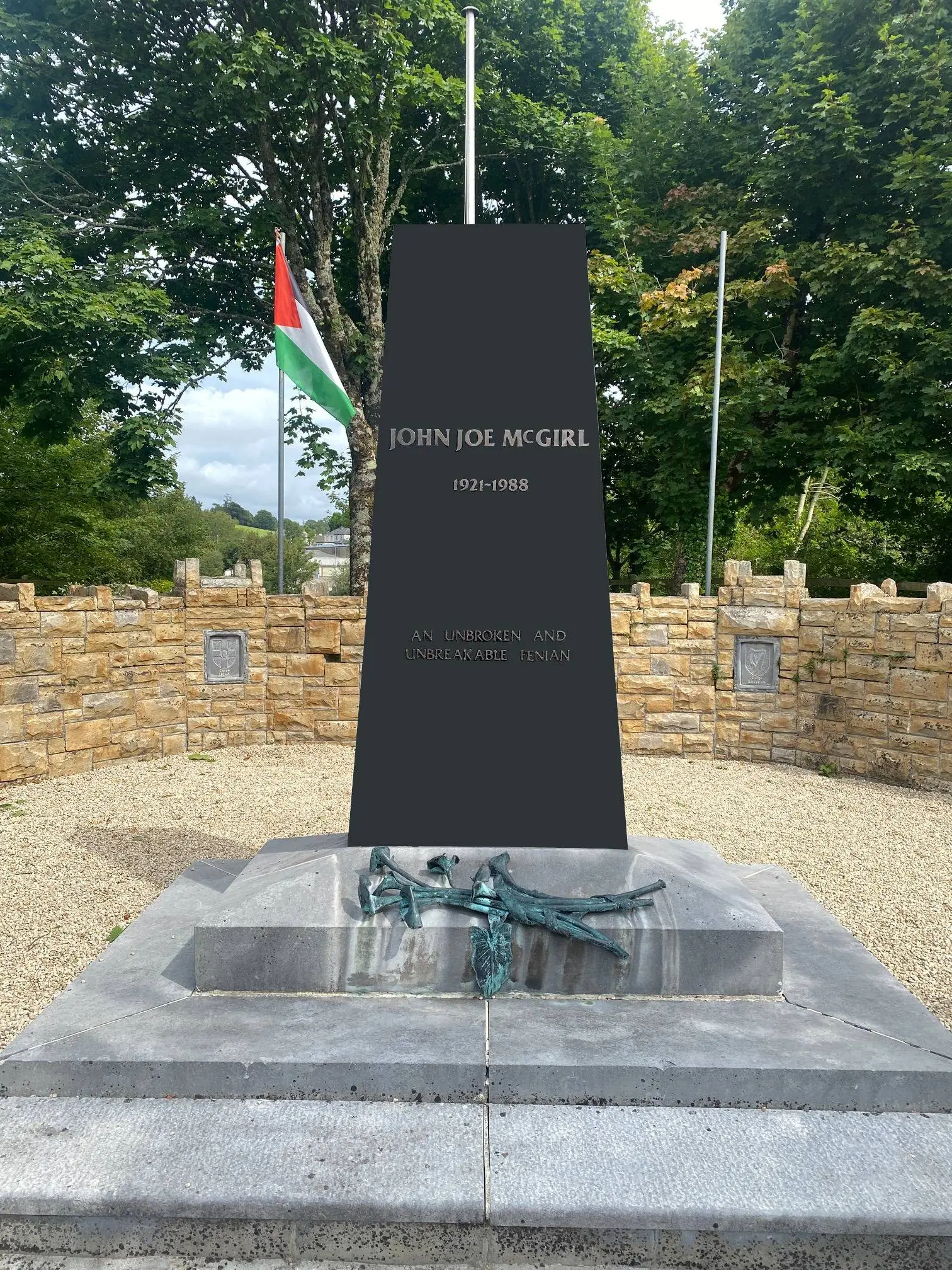
However, in 1937 John Joe McGirl, aged 16, chose to join the small remaining IRA, which was prepared to continue the armed struggle for a 32-county republic. McGirl would go on to dedicate his life to the militant Republican cause. He was involved in the formation of the Provisional IRA when the IRA again split in 1969. Besides being a publican, undertaker and auctioneer, McGirl was elected to Dail Eireann for one term as an abstentionist Teachta Dála (TD) in 1957 while imprisoned for Republican activity. He was elected to Leitrim County Council in 1960 and served as its chairperson for a period in the 1980’s. He was a councillor at the time of his death, aged 67, in 1988.
Gerry Adams, former leader of Sinn Fein, first met McGirl in Ballinamore in the late 1960’s. Adams described him as someone whose first loyalty was to the Republican struggle, for which he endured imprisonment in every decade of his activism. McGirl was involved in the failed IRA campaigns from the late 1930’s to the Border campaign of the 1950’s, and during the more recent Troubles period. Adams stated that after the mass IRA breakout from Long Kesh in 1983, McGirl dispersed a number of the escapees to safe houses around Ballinamore.
The authoritative book Leitrim’s Republican Story, 1900 – 2000 by Cormac O’Suilleabhain provides details of McGirl’s life-long Republican activism, his brief term as IRA Chief of Staff and his political career. It appears that he was held in high regard locally and while many would not have supported his politics, some people were willing to assist him if requested. The book states that ‘Everything that happened in Leitrim in the fight against British occupation for those fifty years [1930’s – 1980’s] invariably centred around him’. In later sections the book gives credence to the claims that the kidnapped racehorse Shergar was buried in McGirl’s home area of Aughnasheelin and the bomb used in the Enniskillen bombing atrocity was constructed in Ballinamore. McGirl’s nephew, Francis McGirl, went on trial for the murder of Lord Mountbatten and three others at Mullaghmore in August 1979. He was subsequently acquitted on lack of evidence, but Thomas McMahon, who was arrested with him, was found guilty and sentenced to life imprisonment. However, it was the Provisional IRA’s kidnap of Don Tidey in 1983 that brought international attention, and a certain national notoriety, to the Ballinamore locality, John Joe McGirl’s area of command.
In May, 1994, six years after McGirl’s death, several hundred people, including Gerry Adams and Martin McGuinness, attended the unveiling of his memorial in Ballinamore. The committee behind the project were members of Sinn Fein rather than a more broadly based local grouping. A substantial element of the funds for the erection of the monument came from the United States. The memorial serves as a reminder of a prominent local politician and lifelong Republican, and also of a darker chapter in our recent history.
Sheehan/Kelly Memorial
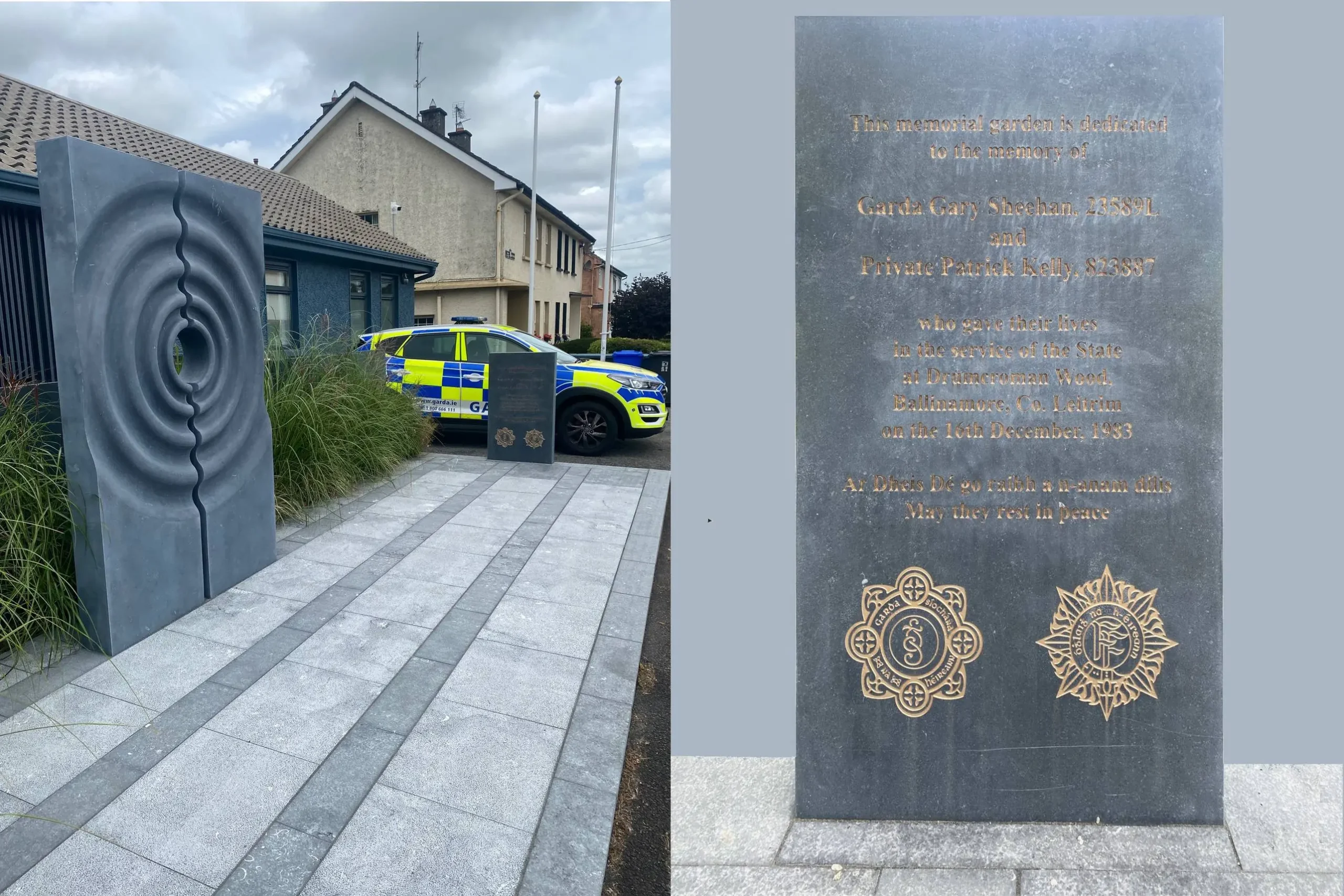
On the 16th December 2024, a memorial was unveiled in Ballinamore honouring two men for their ultimate sacrifice in the service of the Republic 41 years earlier. Private Paddy Kelly, aged 36, a married father of four children, and Garda Recruit Gary Sheehan, aged 23, were involved in a combined Garda and Army search for the kidnapped supermarket executive Don Tidey. The Provisional IRA’s kidnapping in Dublin of Tidey on 24th November 1983, seen as an attack on the state itself, was to end in a hail of gunfire three weeks later in the Derrada Woods area, just north of Ballinamore. One of the largest manhunts in Irish history, which succeeded in freeing Tidey also resulted in the heavily armed IRA gang taking the lives of Gary Sheehan and Paddy Kelly. Another Garda was badly wounded while protecting the just freed Don Tidey in a second violent attack by the escaping IRA unit. Kelly and Sheehan could claim a direct connection to the Selton Hill dead as two of the survivors of that earlier shoot-out subsequently joined the National army and the newly formed Garda respectively. The Irish Army itself traces its roots back through the original IRA to the Irish Volunteers. Their uniform tunic button includes the letters ‘IV’ commemorating the Irish Volunteers.
The location of the kidnap gang’s hideout was no coincidence, it was directly linked to John Joe McGirl’s questionable influence in the Ballinamore area. McGirl was suspected of providing logistic support to the kidnappers and was himself arrested on the morning prior to Tidey’s freeing. According to Leitrim’s Republican Story, after the shoot-out, one group of the escaping IRA kidnap gang asked that word be got to McGirl as to their whereabouts, unaware that he was under arrest. The attitudes of people living in the Ballinamore area came under intense media scrutiny in the aftermath of the Derrada Woods deaths. Somewhat unfairly the media eye homed in on a Leitrim habit of reticence in public statement, a ‘no comment’ trait that has certain advantages in keeping the peace in daily interactions in a sparsely populated rural area where people cannot easily avoid each other. Additionally, the local population did not escape unscathed, a local man, John Gerard Wrynne, was mistakenly shot in the head at a Garda/Army checkpoint shortly after the Derrada killings, narrowly escaping death, and another local had his car shot at by security forces while carrying two gardai. When the media and the heavy Garda and Army presence had left the area, this community would have to pick up the pieces, aware of the continuing presence in their midst of on the run Republicans, some violent. The ongoing security focus on John Joe McGirl and the locality would fail to prevent the manufacture and transfer four years later of the deadly Enniskillen bomb.
There was no nationwide collection to erect a memorial to Gary Sheehan and Paddy Kelly. Sheehan’s young colleagues from Templemore Garda Training college who were pressed into front line service to track down Don Tidey and his captors were understandably traumatised by his murder. They would always remember the details of an operation they were so poorly prepared for, some of them innocently brought along their guitars when they were bussed up to Leitrim. Shortly after Gary’s death they held a collection among themselves to mount a wall plaque in his honour in the Garda College in Templemore. In December 2023, some of his colleagues from the class of 1983, still upset and bitter about his loss, organised a fitting 40th memorial service in Gary’s hometown of Carrickmacross, Co. Monaghan, where he is buried. This in turn led to the unveiling outside Ballinamore Garda station in December 2024 of a fitting memorial to Gary Sheehan and Paddy Kelly.
Legacy
These three memorials may prompt passers-by to ponder some of the more violent periods in our recent history. The Irish public in general would have no hesitation in paying their respects to the dead of Selton Hill and Derrada Woods. Admiration for aspects of the Troubles era, that Leitrim is unfortunately connected to, is not generally forthcoming. Some of John Joe McGirl’s colleagues from the Provisional IRA and Sinn Fein take exception to what they see as a hypocritical attitude to the Republican violence of the Troubles period. They rightly point out that some of the ‘Old IRA’ tactics were violent and cruel and similar to some of the Provisional IRA’s actions during the Troubles. To further promote this notion of equivalence to the ‘Old IRA’, and to excuse their own lack of a democratic mandate or popular support, they take the somewhat bizarre approach of trying to undermine the legitimacy of the mandate Sinn Fein gained from their overwhelming election victory in 1918. The reality is that our admiration for the sacrifices and achievements of militant Republicanism is confined to the 1916 Rising and the War of Independence. That does not mean one has to approve or support a later violent campaign, even one with many similar aims. The War of Independence had popular support and an electoral mandate, it was short lived and successful to the extent of gaining freedom for the 26 Counties. The traumatic Civil War 0f 1922-23 changed totally the people’s attitude to the use of violence to achieve political ends, the appalling violence of the Troubles only served to reinforce that.
The Provisional IRA strategy of bombing public places had no equivalent in the War of Independence and was inexcusable to most people. Despite the evidence that attempted warnings could not prevent the slaughter and injury of innocent civilians, Republican and Loyalist paramilitaries persisted with their bombing outrages. Television brought the worst excesses of the Troubles directly into our living rooms. Anyone who remembers viewing the news footage from Derry’s Bloody Sunday or Belfast’s Bloody Friday, are unlikely to forget the horror perpetrated on innocent civilians by the British Army and the Provisional IRA respectively. To the present day we are occasionally reminded of the depths and legacy of such horror with survivors’ stories from such as the Omagh and Dublin bombings describing things that they can never forget, the loss of loved ones, the smell of burning flesh, and body parts on the street. The level of violence against civilians during the Troubles cannot be justified on any level. An appalling 2086 deaths, 56% of the Troubles fatalities, were civilians. The incidence of civilian deaths in the War of Independence and Civil War was c.40% and c.25% respectively. While Loyalist paramilitaries were responsible for twice as many civilian deaths as Republican paramilitaries, much of their savagery was a direct response to Provisional IRA action and in particular the targeting of the majority Protestant Royal Ulster Constabulary (RUC) and Ulster Defence Regiment (UDR), both on duty and off duty.
The Provisional IRA’s armed campaign never had popular support; it is highly unlikely that it will acquire it retrospectively. History will be kinder to those Republican leaders who, with their skilful handling, managed to convince the Provisional IRA to accept an end to the armed campaign in 1994, some years after John Joe McGirl’s death. Since then, Sinn Fein have made impressive progress in constitutional politics, both in the North and the South. It is not inconceivable that they might be in government in the South, more likely in a coalition, by 2033, the 50th anniversary of the Derrada Woods murders. If that is the case, Sinn Fein ministers might be called upon to honour our dead, which will require an unequivocal acknowledgement as to who were the real heroes at Derrada Woods, Patrick Kelly and Gary Sheehan or their killers.
Notes
All rights reserved by Ken Boyle. Reproduced on Leitrim Books with permission.
To understand the present, it is beneficial to look at what happened in the past. We, with justification, may dislike what occurred. Ken Boyle’s essay vividly illustrated how in South Leitrim, three memorials remember the dead.
A very informative article covering a troubled timei in Leitrim’s history..